
MULTIPLE AWARD WINNING
2000+ HAPPY CUSTOMERS
HAIR TRANSPLANT SCARS · LANCASHIRE
Most men find out about their donor scar in a barber's chair. The clippers go shorter than usual, the barber pauses slightly, and there it is in the mirror behind — a pale line across the back of the head, or a scatter of white dots where the hair used to be thickest.
From that point the question is always the same, and it's the one this guide answers: what can actually be done about it? Not what should have happened at surgery — that ship has sailed — but what the realistic options are now, what each one costs you in money, risk and recovery, and which of them suits the scar you've actually got.
We treat a lot of these. Around 99% of the scar camouflage work at our Rossendale clinic is on hair transplant patients, so we see the full range — fine strip lines, stretched ones, single-session FUE and heavily over-harvested donor areas. This guide includes the options we don't provide alongside the one we do, because sending someone to the wrong treatment helps nobody.
IN THIS GUIDE
It changes which options are open to you
Every option below behaves differently depending on whether your donor area was harvested by strip or by individual extraction. If you're not certain which you had — and plenty of people aren't, particularly after surgery abroad — this is how to tell.
A horizontal band of scar tissue, running some portion of the way from ear to ear. It comes from a strip of scalp being removed and the edges closed together. Width is the variable that matters and it ranges from a couple of millimetres to well over a centimetre, depending mostly on how much tension the closure was under and how your skin healed.
Hundreds of tiny circular scars spread across the back and sides, each one where a punch removed a follicular unit. Individually invisible; collectively a faint stippled or freckled appearance that shows up at short clipper lengths and when the hair is wet.
You may also be looking at depletion, not scarring
If a large number of grafts came out of a concentrated area, the donor region is genuinely thinner than it was — fewer hairs, not just more scars. That looks similar in the mirror but responds differently to treatment, and it's worth having someone tell you which you're dealing with before you pay for anything.
One thing worth saying plainly, because the marketing muddies it: FUE is frequently sold as scarless. It isn't. It avoids a linear scar, which is a real advantage and the main reason the industry moved towards it — but it leaves hundreds of small ones instead. Any clinic using the word scarless without qualification is telling you something about the rest of its claims.
Five routes, honestly rated
There are five genuine approaches to a visible donor scar. Everything else marketed at this problem is a variation on one of them. Here they are side by side before we go through each one properly.
| Option | Works on | Permanent? | Main drawback |
|---|---|---|---|
| Growing it out | Both | No — it's a constraint | Dictates your hair length for life |
| SMP camouflage | Both | Long-term, needs occasional top-ups | Addresses colour, not texture |
| Scar revision surgery | Strip scars only | Yes | Can heal the same width or worse |
| Grafting into the scar | Mainly strip scars | Yes, where grafts survive | Lower take rate; spends donor supply |
| Concealers and fibres | Both | No — daily reapplication | Comes off in rain, water, on collars |
Two of these are surgical, one is cosmetic and temporary, one is free but costs you something else entirely, and one sits in between. Which is right depends far more on your particular scar than on general preference — which is why the section on what decides whether a scar can be hidden matters more than this table does.
Free, effective, and quietly expensive
Nearly everyone tries this first, and it works. Hair over a scar hides a scar. At a number four and above, most donor areas are genuinely difficult to spot, and a lot of men live with theirs perfectly comfortably for years on exactly this basis.
The catch is that it isn't a treatment. It's a rule you now have to follow. And it tends to fail in one of three ways.
Styles change, and so do faces. The look that suited you at 30 often doesn't at 45, and by then a buzz cut may be the most flattering option available to you — except it isn't available.
This is the one people don't see coming. A transplant doesn't stop male pattern hair loss elsewhere. As the top thins further, longer hair starts working against you, and shorter becomes the better look — right at the point the donor area won't allow it.
Wet hair separates and lies flat, and a donor scar that's invisible dry can be obvious at the pool, in the sea, or in a changing room. Swimming comes up in a striking number of our consultations — often as the specific incident that made someone finally look into treatment.
The most common answer, and the reasons why
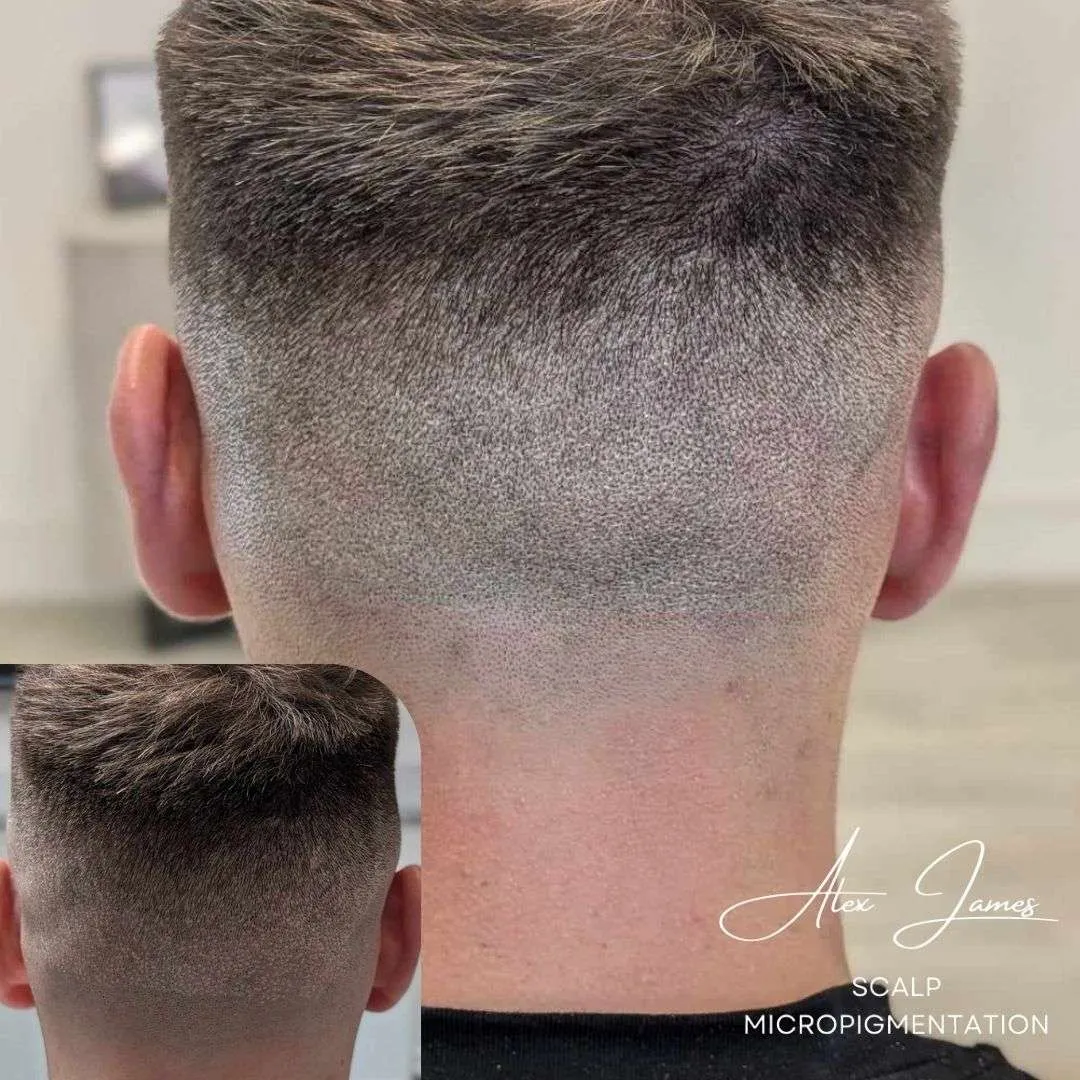
Scalp micropigmentation deposits pigment into the scar tissue to replicate the appearance of hair follicles. It doesn't remove the scar and it doesn't grow hair. What it removes is the contrast — the difference in colour between pale, hairless scar tissue and the darker hair-bearing scalp around it. Contrast is what the eye actually detects, which is why reducing it works as well as it does.
It's the most common route for transplant scarring for practical reasons rather than promotional ones. It's non-surgical, so there's no new wound in skin that has already shown how it heals. It works on both dot scarring and line scarring. And critically, it doesn't consume donor hair — which matters enormously to the people who need it most, since a depleted donor area is often exactly why the scarring is visible.
Flat, white, fully matured scars — which describes the large majority of transplant scarring once healed. Pigment holds well in stable tissue, colour is matched to your existing hair and skin tone, and at conversational distance the result is frequently complete concealment. In our experience there hasn't been a transplant scar we couldn't significantly improve.
Pigment addresses colour, not texture. A scar with significant relief — noticeably raised or indented — will look considerably better but can still catch light at certain angles. That's a real limit and you should hear it before you book, not after.
When the honest answer is no, or not yet
Scars under six months old, scars still pink or red rather than white, keloid scarring, and vitiligo affecting the area are all cases we won't treat. Usually that means wait rather than never — a fresh scar simply needs to finish maturing. Anyone willing to work on a red six-week-old scar is telling you what their standards are.
Full details of how we approach this — session counts, healing stages and pricing, which starts from £150 per session per scar — are on our scar camouflage page. Real before and afters, including both strip and FUE cases, are in the results gallery.
Want to know whether yours can be covered?
Send Alex a photo of the back of your head and you'll get a straight answer — including if that answer is wait six months, or try a surgeon instead.
WhatsApp Alex for a Free Scar AssessmentFree consultations · Alex has had SMP himself · Rossendale, Lancashire
Two options we don't provide, and when they're the better call
Neither of these is something we offer, which is precisely why it's worth reading our account of them. Both are genuinely appropriate in specific cases, and in those cases we say so.
A surgeon cuts out the existing scar and re-closes the wound, aiming for a finer line than the original. It has a real application: a wide strip scar that stretched because it was closed under too much tension can sometimes be substantially improved, particularly if scalp laxity has recovered in the years since.
The risk is straightforward. You're making a fresh wound in skin that has already demonstrated how it scars. It can come back finer. It can also come back the same width, or wider. Revision has essentially no application to FUE dot scarring — there's no single line to excise.
Follicles — sometimes taken from the beard or body rather than the scalp — are transplanted directly into scar tissue so that hair grows through it. When it takes, this is the only option on the list that puts actual hair where there wasn't any, and for a strip scar it can be excellent.
Two caveats. Scar tissue has a poorer blood supply than healthy scalp, so graft survival is lower and less predictable than in normal skin — you should expect a partial result rather than a full one. And it spends donor supply, which is frequently already limited in the people asking about it.
These aren't mutually exclusive with SMP
A common and sensible sequence is surgical work first, then camouflage afterwards to blend whatever remains. Pigment can be applied over a revised or grafted scar once it has fully matured. If you're considering surgery, do that first — the reverse order wastes the SMP work.
If you're weighing surgical against non-surgical approaches to hair loss more broadly, our guide to SMP vs hair transplant covers that comparison in detail.
Including several things sold for this that shouldn't be
Keratin fibres, coloured powders and root sprays all reduce contrast temporarily. They're cheap, reversible and have a legitimate place — a wedding, a holiday photo, a first date. Used that way they're perfectly sensible.
As a daily answer they don't hold up. They transfer onto collars and pillowcases, they run in heavy rain, they're useless in water, and they need reapplying every single morning. Most people who arrive at our clinic have a drawer full of them.
Silicone sheets and scar gels. Genuinely useful on a fresh, raised or reddened scar while it's still maturing, where they can improve the final texture and colour. On a mature white donor scar years after surgery, there is nothing left for them to influence.
Laser resurfacing. Sometimes proposed for scar texture. It may soften a raised edge, but it doesn't restore pigment or hair to scar tissue, and on a scalp donor area it isn't addressing the thing that makes the scar visible.
Standard cosmetic tattooing. Not the same discipline as SMP, despite both involving pigment and a needle. Different pigments, different depth, different needle configuration and a different intended result. Body-ink pigments in a scalp scar have a strong tendency to spread and to shift colour over time — blue-grey is the usual outcome — and correcting that is considerably harder than the original job would have been.
Four factors that matter more than which treatment you pick
Two men can have identical-looking scars and get different results from the same treatment. These are the variables that explain most of that, and they're what any decent consultation should be assessing.
The single biggest factor, and nothing to do with the surgery. Dark hair on pale skin makes pale scar tissue leap out. Lighter or greying hair against similar-toned skin can make the same scar genuinely hard to find. It's also why donor scars often become less noticeable as men grey — and why treatment results tend to hold up especially well in that group.
A flat scar is a colour problem, and colour problems are solvable. A raised or indented scar is partly a shadow problem, and shadows survive pigment. The flatter the scar, the better every non-surgical option performs.
Scar tissue changes for months after surgery. Treating it before it has settled risks uneven pigment retention and a result that shifts as the tissue finishes healing. Six months is the minimum; white rather than pink is the actual test.
This is the one clients under-report, and it changes everything about the plan. Wanting to go from a number four to a number two is a modest ask. Wanting to shave to the skin is a much bigger one, and it needs saying at the consultation rather than six months later. Bring photographs of the length you want, not the length you currently use to hide the scar.
Scar work is a specialism within SMP, not a default part of it
Scar tissue takes pigment differently to healthy scalp and it's far less forgiving of a heavy hand. Plenty of capable SMP practitioners do very little scar work, and the gap between someone who does it regularly and someone who occasionally accepts it shows up in the result.
If you're also considering full scalp coverage rather than scar work alone, it's usually better to plan both together — density either side of the scar can be built to match rather than worked around. Our guide to how many SMP sessions you actually need explains how that's structured, and the scalp micropigmentation page covers the full treatment.
Preventing a scar is far easier than hiding one
If you've found this page while researching a transplant rather than regretting one, this section is the most valuable part of it. We don't perform transplants and have no interest in whether you have one, which is exactly why it's worth hearing.
Before you book anything
The underlying point is that hair loss is progressive and donor supply is finite. The grafts you spend at 28 aren't there at 45, and the scarring you accept then is permanent. A clinic unwilling to talk about that openly is one to walk away from.
Hiding and treating hair transplant scars
Does a hair transplant scar ever go away on its own?
It fades and matures — usually shifting from pink to white over roughly six to twelve months — but it doesn't disappear. Scar tissue is permanent and doesn't grow hair. What changes is how noticeable it is, and that can be influenced considerably.
How short can I cut my hair after a hair transplant?
It varies too much between individuals for a single answer, but most people find the donor area becomes noticeable somewhere around a number two and below. With a strip scar the threshold tends to be sharper — a line either shows or it doesn't. Lowering that threshold is the main thing camouflage is for.
How do I make my donor scar less noticeable without surgery?
Three realistic routes: keep the hair long enough to cover it, use concealers or fibres for occasional situations, or have SMP camouflage to reduce the colour contrast permanently. Of the three, only the last one lets you choose your hair length freely afterwards.
How long after surgery can a scar be treated?
Six months minimum, and the scar needs to be white and settled rather than pink or red. Some take longer. Working on tissue that's still changing risks poor pigment retention and a result that shifts as healing completes.
Can a scar from two or three strip surgeries be treated?
Usually yes, and it's a common case. Repeat strip procedures tend to leave a wider, more irregular scar, which generally means more sessions and a more carefully staged approach — but the principle is unchanged. Send a photograph and you'll get an honest read on what's achievable.
Does treating a scar hurt?
Most clients describe SMP camouflage as mild and easily manageable. Scar tissue frequently has reduced sensation compared with the skin around it, so it can be less uncomfortable than the healthy scalp either side.
Can I still have another hair transplant after SMP?
Yes. SMP doesn't damage follicles or rule out future surgery. Tell any surgeon you consult that you've had it, since it changes how they read the donor area. A lot of clients use camouflage specifically to buy themselves time while they decide whether more surgery is worth it.
ALEX JAMES SMP · ROSSENDALE, LANCASHIRE
Send a photograph of the back of your head and Alex will tell you honestly whether camouflage will work, roughly how many sessions it would take, and whether you'd be better off waiting or seeing a surgeon first. No pressure, no obligation.
WhatsApp Alex for a Free Consultation