
MULTIPLE AWARD WINNING
2000+ HAPPY CUSTOMERS
SMP REMOVAL · ROSSENDALE, LANCASHIRE
SMP can completely transform how someone feels about their appearance — but what happens when that transformation no longer fits who you are? Whether you're dealing with faded pigment that's turned an unnatural colour, work that no longer suits your style, or a result that wasn't what you expected, scalp micropigmentation removal is a safe and effective option when carried out by the right specialist.
At Alex James SMP Clinic & Training Academy in Rossendale, Lancashire, we work with clients from across the North West — including Manchester, Burnley, Blackburn, Bolton and Bury — who need expert removal, correction or preparation for a new SMP design. This guide explains exactly how removal works, what the different methods involve, and what you can realistically expect throughout the process.
IN THIS GUIDE
Every case is individual — and every case deserves a proper assessment
There are several reasons a person may explore removal. Sometimes it's purely aesthetic; in other cases the motivation is emotional, medical, or simply a desire to start fresh. The most common situations we see are:
Pigment colour change or migration
Over time, pigment can oxidise or shift slightly, giving a bluish cast or blurred appearance that no longer looks natural.
Design correction or shape revision
Hairline styles change. A design that looked right five years ago may no longer suit your features or preferences.
Poor quality original work
SMP is occasionally performed by under-trained practitioners. Uneven dot patterns or incorrect pigment depth may require expert correction or removal.
Medical or allergic reasons
Although rare, sensitivity to pigment or long-term dermatological issues can make removal advisable.
Preparation for new SMP
Fading or lightening an existing treatment before re-pigmentation ensures a cleaner, more accurate canvas for the new work.
Each situation requires an individualised clinical assessment. At Alex James SMP Clinic & Training Academy, every removal consultation begins with a thorough evaluation of skin type, pigment behaviour and the original technique used, to determine the safest, most effective approach for your specific scalp.
Understanding what we're removing — and why it's more complex than it looks
SMP pigments are deposited only fractionally below the epidermis — typically 0.5–1mm into the upper dermis. This shallow placement is deliberate: it allows light to reflect through the pigment particles and create the visual illusion of tiny hair follicles. But pigment particles don't remain static.
Over months and years, the body's immune system gradually encapsulates and breaks down microscopic fragments, while UV exposure and natural skin turnover alter colour tone. Because SMP pigments are carbon-based and extremely fine, they often appear softer and greyer over time compared with traditional tattoo inks.
When a laser or other removal technique is applied, the energy targets these suspended pigment granules. The goal is not to "lift ink out" but to fragment or displace particles enough for the lymphatic system to remove them naturally over the following weeks. The key challenge is delivering sufficient energy to break pigment bonds without overheating or traumatising the surrounding scalp tissue.
Several factors influence how pigment behaves — and therefore how removal must be approached:
Depth of placement
Too deep and pigment blurs or discolours. Too shallow and it fades unevenly. Both affect how removal must be calibrated.
Pigment composition
Carbon-based SMP pigments respond differently to laser wavelengths than traditional tattoo inks or older iron-oxide formulas.
Skin physiology
Fitzpatrick skin type, oil production and previous sun exposure can all alter pigment stability and removal response.
Aftercare history
Poor healing or unprotected sun exposure often accelerates fading or colour change, affecting the starting point for removal.
Three principal approaches — each with different strengths
There are three principal approaches to reducing or removing SMP pigment. Each has benefits and limitations that depend on pigment type, density and the desired end result.
Laser removal
The most widely used and clinically proven method. Short bursts of light energy are selectively absorbed by pigment particles, shattering them into microscopic fragments which the body's lymphatic system removes naturally over several weeks. Multiple sessions are required for complete clearance, but modern Q-switched and picosecond lasers offer precision that minimises risk to the scalp.
Saline removal
A sterile saline solution is introduced into the treated area, creating an osmotic gradient that draws pigment particles upward through the skin during healing. Effective for small corrections or lightening, but slower than laser and carries a higher risk of surface irritation if performed aggressively.
Gradual fading / micro-exfoliation
For clients who want only to soften density or prepare for a redesign, controlled micro-exfoliation can encourage gradual fading. Not technically removal and not performed in isolation at our clinic — but a legitimate adjunctive pathway when tonal reduction rather than full clearance is the goal.
How selective photothermolysis targets pigment without harming surrounding skin
Laser technology works through selective photothermolysis — light of a specific wavelength is absorbed by the carbon pigment more readily than by surrounding tissue. The pigment briefly heats and shatters into smaller fragments, which the body's macrophages then clear. Because SMP pigment sits near the surface, laser fluence can be kept relatively low compared with body tattoo removal, minimising discomfort and reducing the likelihood of blistering or hypopigmentation.
Q-Switched ND:YAG (1064nm and 532nm)
The workhorse of SMP removal. The 1064nm wavelength targets carbon pigment efficiently; 532nm may address residual reddish tones from older pigment formulations.
Picosecond lasers
Ultra-short pulses generate a photo-acoustic rather than thermal effect — pigment is shattered mechanically rather than burned. This can mean faster clearance and less irritation in certain cases.
Alexandrite (755nm)
Sometimes used for stubborn or multi-tonal pigment. Requires careful calibration for lighter skin tones to avoid hypopigmentation.
Most clients describe the sensation as mild warmth or a quick elastic snap. Topical anaesthetic and chilled air are used for comfort. Immediately after treatment, frosting (a temporary whitening of the skin surface) indicates the pigment is reacting — this settles within minutes. Post-treatment, the area may appear slightly pink or raised, which subsides within 24 hours. The body continues clearing pigment for several weeks before the next session, which is why sessions are spaced 4–6 weeks apart.
Laser parameters are set individually — not as standard
At Alex James SMP Clinic & Training Academy, laser settings are customised following patch testing and assessment of pigment density and skin type. There is no single default setting — every scalp is assessed individually to ensure safe and even fading.
Three principal approaches — each with different strengths
There are three principal approaches to reducing or removing SMP pigment. Each has benefits and limitations that depend on pigment type, density and the desired end result.
Laser removal
The most widely used and clinically proven method. Short bursts of light energy are selectively absorbed by pigment particles, shattering them into microscopic fragments which the body's lymphatic system removes naturally over several weeks. Multiple sessions are required for complete clearance, but modern Q-switched and picosecond lasers offer precision that minimises risk to the scalp.
Saline removal
A sterile saline solution is introduced into the treated area, creating an osmotic gradient that draws pigment particles upward through the skin during healing. Effective for small corrections or lightening, but slower than laser and carries a higher risk of surface irritation if performed aggressively.
Gradual fading / micro-exfoliation
For clients who want only to soften density or prepare for a redesign, controlled micro-exfoliation can encourage gradual fading. Not technically removal and not performed in isolation at our clinic — but a legitimate adjunctive pathway when tonal reduction rather than full clearance is the goal.
Thinking about SMP removal or correction?
Book a free consultation at our Rossendale clinic. We'll assess your pigment, explain your options honestly, and outline a realistic treatment plan — no pressure to commit.
WhatsApp Alex for a Free ConsultationClients travel from Manchester, Burnley, Blackburn, Bury, Bolton and across Lancashire
Why no two removal plans look the same
No two scalps are identical. Pigment chemistry, placement depth and skin response vary widely, which is why combination removal strategies often yield the most refined outcomes. At Alex James SMP Clinic & Training Academy, laser and non-laser methods are blended to take advantage of each method's strengths.
A common approach begins with several sessions of low-fluence laser to fragment the bulk of pigment particles. Once residual pigment sits nearer the surface, a saline session or controlled exfoliation removes what remains. This reduces total laser exposure and gives a smoother, more even finish.
For clients with reactive skin, alternating between gentle laser passes and saline lifting provides rest periods between energy-based treatments. The scalp is allowed to heal fully, reducing cumulative inflammation and maintaining dermal integrity.
Initial assessment and patch test
Pigment response to a small test pulse confirms energy tolerance and ensures no unusual oxidation occurs before proceeding across the scalp.
First full session
Treatment covers the entire target area. Immediate frosting or mild redness is normal and subsides within hours. Detailed aftercare instructions are provided.
Healing interval — 4 to 6 weeks
The skin recovers and the lymphatic system processes pigment fragments. Shorter intervals risk irritation; the body needs time to complete its work between sessions.
Subsequent sessions
Each visit builds on the last. Clients typically see 20–40% pigment reduction after the first session, with further improvement each time. Lighter densities may need 2–3 sessions; deeper or older pigment can require 5 or more.
Final evaluation and refinement
Once the desired clearance is achieved, a final review ensures uniform tone and smooth skin. If new SMP is planned, waiting at least 8 weeks allows full dermal stabilisation before re-pigmentation.
How selective photothermolysis targets pigment without harming surrounding skin
Laser technology works through selective photothermolysis — light of a specific wavelength is absorbed by the carbon pigment more readily than by surrounding tissue. The pigment briefly heats and shatters into smaller fragments, which the body's macrophages then clear. Because SMP pigment sits near the surface, laser fluence can be kept relatively low compared with body tattoo removal, minimising discomfort and reducing the likelihood of blistering or hypopigmentation.
Q-Switched ND:YAG (1064nm and 532nm)
The workhorse of SMP removal. The 1064nm wavelength targets carbon pigment efficiently; 532nm may address residual reddish tones from older pigment formulations.
Picosecond lasers
Ultra-short pulses generate a photo-acoustic rather than thermal effect — pigment is shattered mechanically rather than burned. This can mean faster clearance and less irritation in certain cases.
Alexandrite (755nm)
Sometimes used for stubborn or multi-tonal pigment. Requires careful calibration for lighter skin tones to avoid hypopigmentation.
Most clients describe the sensation as mild warmth or a quick elastic snap. Topical anaesthetic and chilled air are used for comfort. Immediately after treatment, frosting (a temporary whitening of the skin surface) indicates the pigment is reacting — this settles within minutes. Post-treatment, the area may appear slightly pink or raised, which subsides within 24 hours. The body continues clearing pigment for several weeks before the next session, which is why sessions are spaced 4–6 weeks apart.
Laser parameters are set individually — not as standard
At Alex James SMP Clinic & Training Academy, laser settings are customised following patch testing and assessment of pigment density and skin type. There is no single default setting — every scalp is assessed individually to ensure safe and even fading.
What's true, what's not, and why it matters
"Laser burns the scalp"
Modern laser systems are extremely precise and designed to protect surrounding skin. When operated correctly, there is no burning — only controlled pigment fragmentation through targeted energy absorption.
"It only takes one session"
Pigment resides across multiple dermal levels and densities. Gradual, spaced treatment is necessary for safety and for allowing the body to flush fragments between sessions. Expect several sessions for optimal results.
"Removal damages existing hair"
The laser targets pigment, not hair follicles. When the correct wavelength and fluence are used, natural hair growth is unaffected. Any mild temporary shedding that occasionally occurs resolves naturally.
"Saline is more natural, so it's safer"
Safety depends on practitioner skill, not just the product. Both saline and laser are safe when performed by qualified specialists — and both can cause irritation or damage if misused.
"Home remedies can fade SMP"
DIY methods risk infection, scarring and unpredictable colour changes on the scalp. Professional supervision is the only responsible route to safe pigment reduction.
Honest expectations from someone who understands both SMP creation and removal
The success of SMP removal depends on multiple biological and procedural factors. Understanding the nuances ensures realistic expectations and satisfaction with the final outcome.
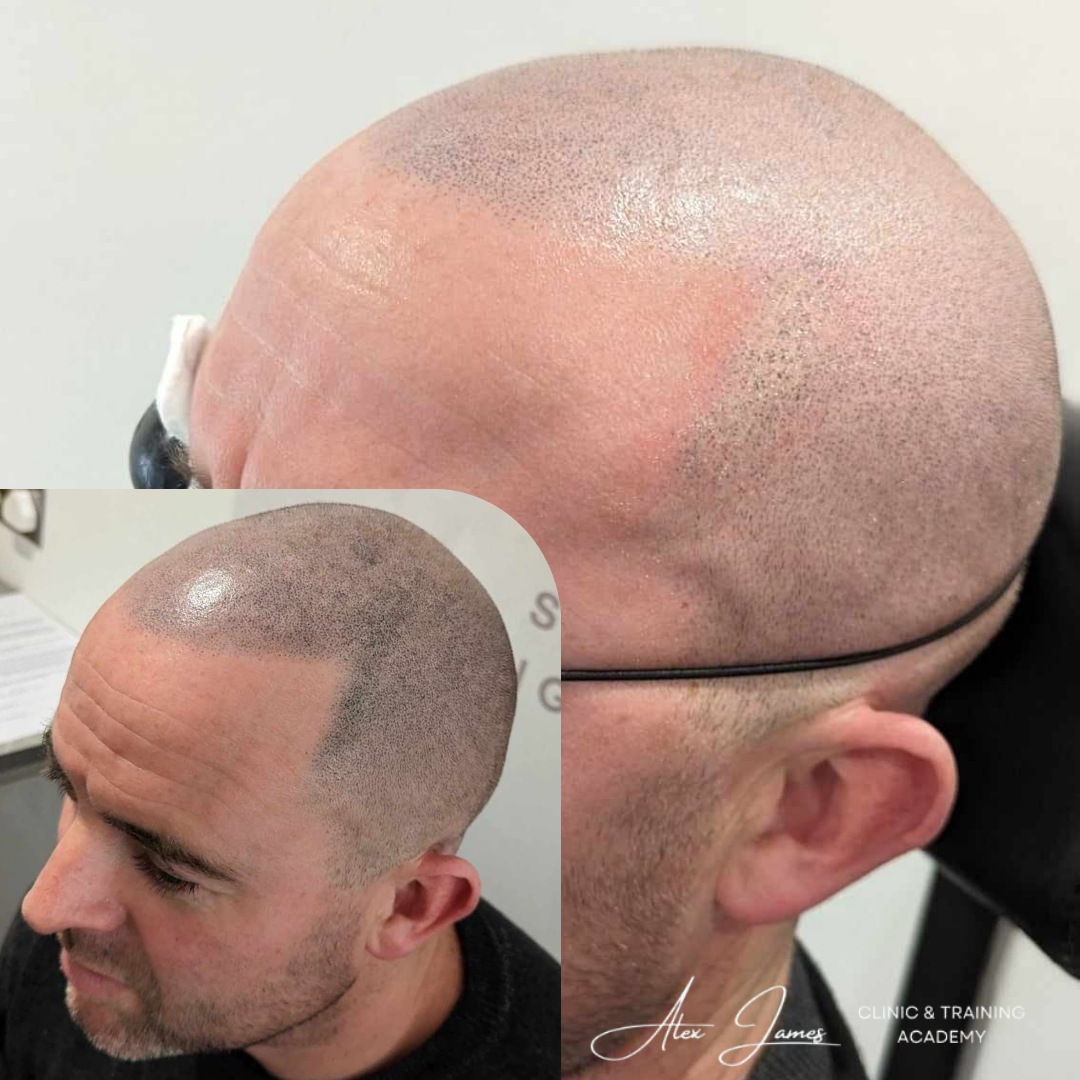
Not every client pursuing removal wants a completely blank canvas. A good illustration: a client came to us with SMP that was far too dense and dark for his complexion — excessive pigment layering that had blurred together into a block-coloured appearance. After three low-fluence laser sessions, the harsh contrast softened significantly. Rather than pursue total removal, he chose to retain some residual pigment as a natural shadow effect. The result was restored confidence and a better SMP than he'd started with — achieved through removal, not addition.
Residual "ghosting" is sometimes expected — and acceptable
Near-complete clearance is achievable for most clients, but a faint shadow may remain under certain lighting conditions, particularly on lighter scalps. This is not poor technique — it reflects microscopic pigment remnants in the upper dermis. For many clients, this subtle shadow is indistinguishable from natural scalp tone and preferable to over-treatment that risks skin texture changes.
SMP REMOVAL · ROSSENDALE, LANCASHIRE
Book a free consultation at our Rossendale clinic. We'll assess your pigment honestly, explain what's achievable, and give you a clear treatment plan — no pressure to commit to anything.
WhatsApp Alex for a Free ConsultationPHONE
LOCATION
538 Burnley Rd, Crawshawbooth, Rossendale BB4 8NE
Mon–Fri 9AM–4PM · Sat 9AM–12PM
