
MULTIPLE AWARD WINNING
2000+ HAPPY CUSTOMERS
HAIR LOSS TREATMENTS · LANCASHIRE
PRP and SMP both appear in conversations about hair loss treatment — but they do fundamentally different things. One is biological. One is cosmetic. Choosing between them, or understanding whether you need both, depends entirely on where your hair loss is at and what you're actually trying to achieve. Getting this distinction wrong means either spending money on a treatment that can't help you, or delaying a result you could already have.
At Alex James SMP, both treatments are available under one roof. Alex handles SMP — and has had it himself, so there's no guesswork about what the result actually looks like. Dawn is our dedicated PRP specialist. Between them, they've assessed every combination of hair loss pattern and treatment goal you can imagine. This guide gives you the honest picture on both, including where one is clearly the wrong choice.
How platelet-rich plasma works on the scalp — and what it's actually doing
PRP stands for platelet-rich plasma. The treatment starts with a small blood draw — your own blood, taken at the clinic. That blood is spun in a centrifuge to separate and concentrate the platelets, which are the component of your blood responsible for healing and cell regeneration. The resulting platelet-rich plasma is then reintroduced into the scalp via microneedling or injection.
Platelets contain growth factors — proteins that signal cells to repair and regenerate. When concentrated and delivered directly into the scalp, they stimulate the follicles in that area: improving blood supply, strengthening existing hair shafts, and in some cases reactivating follicles that have become dormant but haven't yet fully died.
At Alex James SMP, Dawn delivers PRP as part of a 5-in-1 protocol — combining the PRP with microneedling to create micro-channels in the scalp that maximise how deeply the growth factors penetrate. A standard initial course is four sessions, spaced four to six weeks apart. After that, most clients maintain results with one or two sessions per year.
The single most important thing to understand about PRP
PRP only works where viable follicles still exist. It stimulates follicles — it doesn't create new ones. If an area of your scalp has been completely bald for several years, the follicles there are likely no longer active, and no amount of PRP will bring them back. This is the defining limitation of the treatment, and it determines who is and isn't a suitable candidate.
For suitable candidates — typically people in the early to mid stages of hair loss — PRP can produce visible improvements in hair density, a reduction in shedding, and thicker, stronger individual hair shafts. Some clients see regrowth in areas of diffuse thinning where follicle activity is still present but reduced.
PRP cannot restore a hairline that has already significantly receded. It cannot reverse baldness in areas where follicle activity has ceased. It will not produce the same visual result as a cosmetic treatment — the outcome depends entirely on how your follicles respond, and results vary between individuals.
Dawn's assessment process
Before starting a PRP course, Dawn assesses your hair loss pattern, the extent of existing follicle activity, and whether the areas you want to treat are likely to respond. If PRP isn't going to deliver meaningful results for your situation, she'll tell you that clearly — rather than taking your money for a course that won't work.
How SMP works — and what makes it different in principle
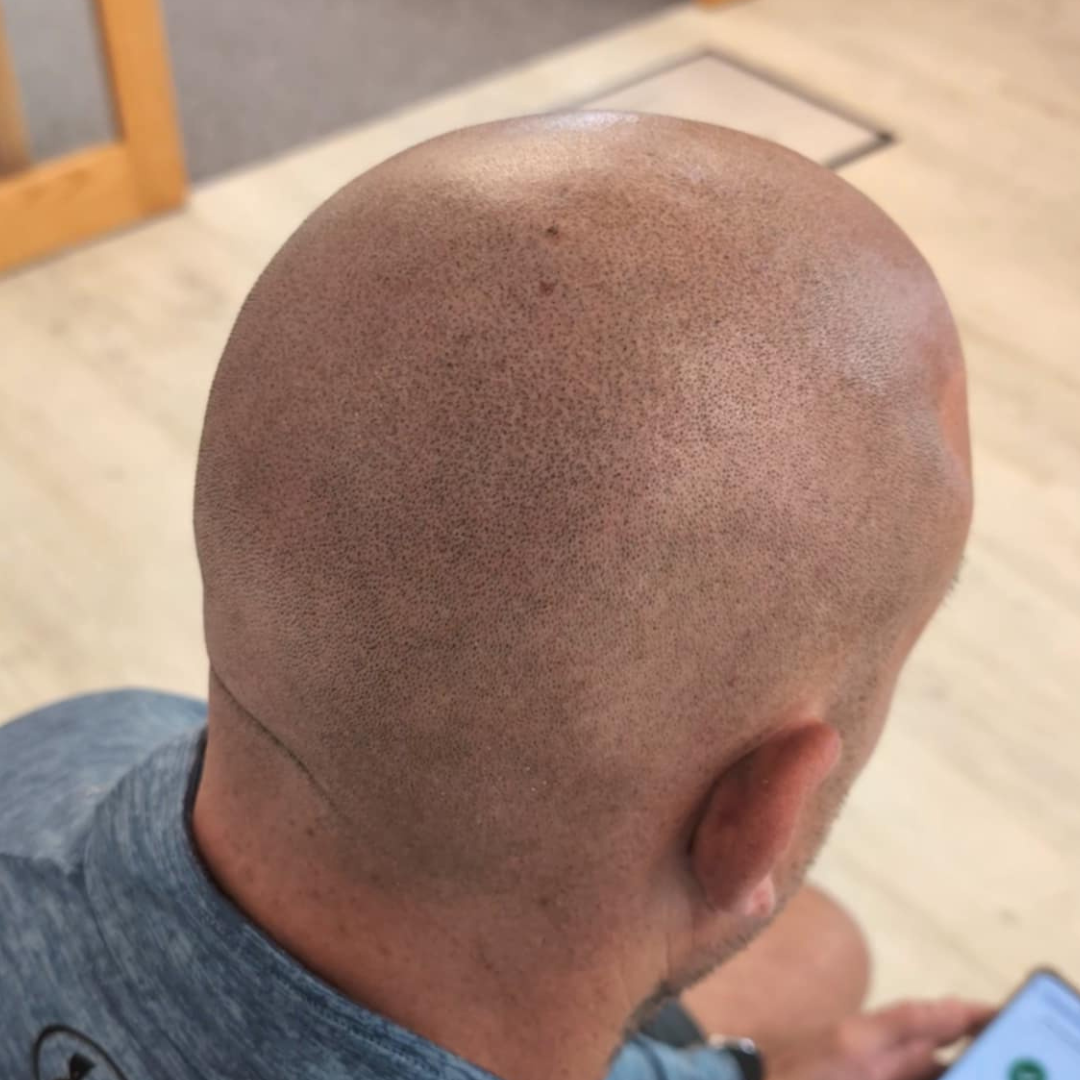
Scalp micropigmentation is a cosmetic procedure that deposits small dots of pigment into the upper layers of the scalp skin, precisely replicating the appearance of hair follicles. The result is the look of a closely shaved head — a defined hairline, consistent density across the scalp, and a visual impression of hair where it no longer grows naturally.
SMP doesn't attempt to change what's happening biologically. It has no effect on your follicles, your hormones, or your rate of hair loss. What it does is address the visual result of hair loss — reliably, predictably, and regardless of how much follicle activity you have left. It works the same whether you have mild thinning or complete baldness, because the treatment isn't dependent on your biology cooperating.
Treatment takes two to three sessions spaced two to three weeks apart. The result is visible from the first session and fully apparent once all sessions are complete and the skin has healed — typically four to six weeks after the final appointment. Alex underwent SMP himself, which means at every consultation you can see an in-person reference for what a real, healed result actually looks like — not just a photo on a screen.
The key advantage of a cosmetic approach
Because SMP doesn't rely on your follicles to do anything, the result is consistent and predictable. You know what you're getting before you start. That's a meaningful difference from a biological treatment where individual response varies and outcomes aren't guaranteed.
A defined, natural-looking hairline. Consistent density across the scalp. The appearance of a shaved head with hair — regardless of the underlying baldness. Results that hold well for three to five years before a touch-up is beneficial. No daily maintenance, no ongoing treatment schedule.
Real hair growth. Physical texture or volume. A result that looks natural with longer hair — SMP works best when natural hair is kept short, at a grade 0 to grade 2. If you want to wear your hair at medium or longer length, SMP won't blend convincingly at the hairline.
Understanding this one distinction makes the whole comparison clearer
These treatments get compared as if they're alternatives doing the same job. They're not — and that framing causes people to make the wrong choice. The simplest way to understand the difference:
PRP
Tries to improve what's happening with your hair
Biological. Stimulates follicle activity. Requires live follicles to work. Results vary by individual.
SMP
Addresses how your hair loss looks
Cosmetic. Creates appearance of hair. Works regardless of follicle activity. Predictable, consistent result.
The right question to ask yourself is not "which treatment is better?" — it's "what am I actually trying to solve?" If the answer is preserving and improving the hair you still have, PRP is the relevant treatment. If the answer is addressing how your hair loss looks, SMP is the more direct solution. If both are true, they can be used together.
Where the comparison breaks down entirely
For men with advanced hair loss — significant baldness at Norwood 5, 6, or 7 — PRP is not a realistic option for the bald areas. The follicles aren't there to stimulate. SMP is often the only cosmetic solution available short of surgery, and it works extremely well for this group. Comparing PRP and SMP as equals for someone in this situation is a false comparison.
Not sure which treatment applies to your situation?
A free consultation at Alex James SMP covers both PRP and SMP — with Alex and Dawn both available. You'll get a straight answer about what makes sense for your hair loss, not a recommendation based on what costs more.
WhatsApp Alex for a Free ConsultationFree consultations available · See Alex's own SMP results in person · Currently booking 2–3 weeks ahead
The situations where PRP is likely to produce meaningful results — and where it isn't
PRP produces its best results for people who are earlier in their hair loss journey — where thinning has started but follicle activity across the affected areas is still meaningful. The treatment works by enhancing what those follicles are already doing. The more there is to work with, the better the outcome.
PRP is a treatment with a reasonable evidence base for suitable candidates — but it's not a guaranteed fix, and individual results vary. Some clients see significant improvements in density and shedding. Others see more modest changes. Dawn assesses every PRP client individually and will give you an honest view of what you're likely to achieve before you commit to a course.
A note on managing expectations with PRP
PRP doesn't restore a hairline that's already significantly receded, and it won't produce the look of a full head of hair where coverage has been lost. If that's what you're hoping for, the honest answer is that PRP isn't the right tool — and having that conversation before you spend money on a four-session course is exactly what the consultation is for.
The situations where SMP is the more direct and reliable answer
Because SMP is a cosmetic solution rather than a biological one, it works across a wider range of hair loss situations — including many where PRP would be ineffective or irrelevant. The key question isn't whether your follicles can respond. It's whether the visual result SMP delivers is what you're actually looking for.
The men who are happiest with their SMP
Consistently, the clients who are most satisfied with SMP are those who've accepted their hair loss and made a deliberate, confident decision about how they want to look — rather than those who are hoping SMP will make them look like they never lost any hair. SMP is a strong, clean aesthetic choice. It works best when it's chosen on those terms.
Key factors compared directly
| PRP | SMP | |
|---|---|---|
| What it does | Stimulates existing follicles biologically | Creates visual appearance of hair |
| Needs active follicles? | Yes — essential | No |
| Result | Improved real hair density/thickness | Consistent visual hairline and density |
| Result predictability | Variable — depends on individual response | High — consistent regardless of biology |
| Time to see results | 3–6 months | Visible from session 1; full result ~6 weeks post-final session |
| Initial sessions | 4 sessions over 4–6 months | 2–3 sessions over 4–6 weeks |
| Long-term maintenance | 1–2 sessions/year ongoing | Touch-up every 3–5 years |
| Hair length flexibility | Any length | Short (grades 0–2) works best |
| Works on full baldness | Generally no | Yes |
| Downtime | 24–48 hours | Keep scalp dry 4 days post-session |
| Starting cost | £250/session (course of 4 = £1,000) | From £1,250 (full treatment, all sessions) |
When combining both treatments makes sense — and how to sequence them
Yes — and for some clients, combining both is the most logical approach. Because they target completely different things, they don't conflict with each other. PRP addresses the biological health of your follicles. SMP addresses the visual result of hair loss. Used together, they work in parallel.
A combined approach might look like this: PRP to preserve and improve existing hair density in thinning areas where follicle activity remains, alongside SMP to address a receding hairline or bald areas where PRP would have no effect. The PRP works on what's there; the SMP covers what isn't.
If you're planning both treatments in the same area, sequencing is important. SMP should generally be completed first and fully healed before PRP begins in that region. The microneedling involved in PRP can disrupt pigment that hasn't yet fully settled in the dermis. As a general guideline, allow at least four to six weeks after your final SMP session before starting PRP in the same area.
Once SMP is healed, ongoing PRP maintenance in the same area is not a problem — the pigment is stable and microneedling over it at normal treatment depth won't affect it.
One thing that makes this easier at Alex James SMP
Because Alex and Dawn both work at the same clinic, a combined treatment plan doesn't require coordinating between separate providers who've never spoken to each other. If both treatments are on your radar, mention it at consultation — we'll design a plan that sequences everything properly from the start, rather than you piecing it together yourself.
Men who have some active hair loss in thinning areas — worth preserving with PRP — alongside a receding hairline or areas of more complete baldness they want to address cosmetically with SMP. This is actually a common profile for men in their 30s and early 40s, and both treatments sit alongside each other well as part of a longer-term plan.
Transparent pricing for both treatments — including the long-term picture
PRP sessions are priced at £250 per session. A standard initial course of four sessions totals £1,000. After the initial course, ongoing maintenance is typically one to two sessions per year — meaning an ongoing annual cost of £250–£500 to sustain results indefinitely.
SMP is priced per full treatment course, covering all sessions needed to complete the result. Receding hairline treatment starts from £1,250. Full scalp coverage starts from £1,550. A touch-up session every three to five years is available at a significantly lower cost than the original treatment — there's no full retreatment needed. See the full SMP cost guide for a detailed breakdown by treatment type.
Over a five-year period, the costs are broadly comparable. Four initial PRP sessions plus two maintenance sessions per year for four subsequent years = approximately £1,000 + £2,000 = £3,000 over five years. Full scalp SMP at £1,550 plus one touch-up is typically under £2,000 over the same period. PRP's ongoing cost reflects that results need sustaining continuously. SMP's higher upfront commitment reflects that it holds significantly longer between interventions.
Cost shouldn't be the deciding factor
Over a long enough horizon, both treatments cost meaningful money. The right question is which one is appropriate for your hair loss situation and your goals — not which one is cheaper. Spending £1,000 on a PRP course when your follicles are no longer viable is a more expensive mistake than the cost difference between the two treatments.
Common questions when comparing PRP and SMP
Which treatment gives faster visible results?
SMP by a significant margin. Results are visible from the first session, with the full result apparent within four to six weeks of the final appointment. PRP results develop gradually over three to six months as follicles respond — and the improvement is often more noticeable to the person receiving treatment than to others. If timeline matters, SMP is the faster answer.
Is PRP painful?
PRP involves microneedling across the scalp and targeted injections, so there is discomfort — more so than SMP in some areas. A topical numbing cream is applied before treatment to manage sensitivity. Most clients describe it as a manageable scratching or stinging sensation that settles quickly after the session. Dawn uses a technique designed to minimise discomfort throughout.
Can PRP reverse existing baldness?
No — not in areas where follicles have stopped functioning. PRP can improve the output of follicles that are still active but underperforming, and may stimulate some regrowth where follicles are dormant rather than fully inactive. It cannot restore hair in areas that have been completely bald for a sustained period. This distinction is critical to setting realistic expectations.
Does SMP look natural on thinning hair — not just full baldness?
Yes. For clients with thinning rather than complete hair loss, SMP is placed between existing hair shafts to add visual density — the result is a fuller-looking, more consistent appearance. The key is keeping the hair short enough that the SMP and natural hair length appear consistent. At a grade 1–2, the blend is typically seamless. At longer lengths, the contrast between pigmented areas and natural hair above them becomes more noticeable.
Will PRP affect SMP that's already on my scalp?
Once SMP is fully healed, PRP — including the microneedling component — can generally be performed in the same area without disrupting the pigment. The critical factor is timing: allow at least four to six weeks after your final SMP session before starting PRP in the same region, to ensure the pigment has fully settled before microneedling is applied over it.
I've been losing hair for years. Is it too late for PRP?
It depends on how much follicle activity remains in the areas you want to treat. Years of hair loss doesn't automatically mean PRP is ineffective — many men have diffuse thinning over a long period where follicles remain active but weakened. Dawn's assessment will tell you whether there's enough there for PRP to work with. If there isn't, she'll say so — and at that point, SMP may be the more realistic path to the result you're looking for.
ALEX JAMES SMP · ROSSENDALE, LANCASHIRE
A free consultation at Alex James SMP covers PRP, SMP, or a combined approach. You'll get a straight, honest assessment of what actually makes sense for your hair loss — not a recommendation driven by which treatment earns more.
WhatsApp Alex for a Free Consultation