
MULTIPLE AWARD WINNING
2000+ HAPPY CUSTOMERS
LASER PMU REMOVAL · LANCASHIRE
Microblading and semi-permanent brow techniques transformed the way people frame their faces. But as pigments age, trends shift and techniques vary, it's increasingly common to want them gone — or at least significantly faded. At Alex James Clinic in Rossendale, Lancashire, we specialise in laser eyebrow tattoo removal using ND:YAG technology: a safe, controlled and effective way to fade or fully remove unwanted brow pigment.
Whether your brows have turned an unexpected colour, blurred beyond recognition, or simply no longer suit your face, this guide covers everything you need to know — from how the laser works, to what each session feels like, to what realistic results look like over time.
IN THIS GUIDE
When "semi-permanent" doesn't behave the way it should
Although marketed as semi-permanent, microblading rarely fades evenly or predictably. Many people find that brows they loved in year one gradually become something very different — blurred, discoloured, or simply out of sync with how they look now.
One of the most common reasons clients seek removal is unexpected colour shift. A large percentage of microblading pigments contain iron oxides or titanium dioxide. As these degrade in the skin, warm browns can turn orange or red. Cool browns may fade ashy, grey or even blue. These shifts don't always reflect poor technique — they're often the natural evolution of PMU pigment in your skin.
Brow fashions evolve quickly. What felt right several years ago may now appear too rounded, too high, too thick or too square. Some clients never felt their brows suited them but didn't know where to go for help. Others had brows implanted too deeply, causing strokes to blur prematurely or stay stubbornly saturated for years.
As PMU gained popularity, so did cases of clients accumulating several layers of pigment — different brands, different colour bases — from multiple artists over the years. This creates a dense, shadowy appearance that no longer resembles microblading at all. Removal helps restore clarity and gives corrective brow artists a clean, workable base.
Whatever your reason for removal
Whether you want full removal, a lighter starting point for corrective work, or simply to soften overly harsh brows — laser removal offers a controlled solution for all of these concerns.
Understanding what's actually happening beneath the surface
Unlike body tattoos, which penetrate deeper into the dermis, microblading is designed to sit in the upper layers of the dermis so that it fades over time. In theory this leads to natural softening — but pigment rarely fades uniformly. Depth of implantation, pigment formulation, skin type and previous corrections all influence how the brows age.
Because the brows sit on a highly expressive area of the face, the skin around the eyebrows undergoes constant movement. This causes pigment to spread microscopically over time, changing the crisp hair-stroke effect into a smudge or haze. Clients often say their brows "blurred," "faded strangely," or "don't look like strokes anymore." This is a normal evolution of old PMU pigment — not necessarily a sign of poor original work.
Iron oxide pigments oxidise as they degrade — which is why some brows shift toward red, orange or salmon. Carbon-based pigments tend to fade grey or ashy. Titanium dioxide, used to add opacity, can cause pigment to resist fading and sometimes darken temporarily during laser treatment.
Your natural skin undertone plays a role too. Warm undertones may push pigment into a reddish zone as it breaks down. Cooler undertones may cause brown pigments to appear grey or blue. None of these changes can be fixed by adding more pigment — in fact, layering more PMU over discoloured brows typically makes the result harder to correct later.
Multiple layers from different artists
If you've had PMU done by multiple artists over the years — each using different brands or colour bases — your brows may contain several layers of varying undertones. This is why some brows appear patchy or "muddy" under natural light. Removing these layered pigments is the most effective way to give corrective brow work a clean, accurate base.
Safe, non-invasive, and predictable — especially on the face
Laser removal works by precisely targeting pigment molecules beneath the skin using controlled light energy. The pigment absorbs the laser's energy more quickly than surrounding tissue, causing the particles to shatter into smaller fragments. Your immune system then gradually flushes these out over the following weeks — making it a non-invasive method compared to saline removal, which involves breaking the skin surface to lift pigment out manually.
Laser is ideal for discoloured brows, overly saturated brows, blurred strokes, or residual PMU from multiple sessions. It's also excellent for preparing skin for new brows — many PMU artists won't work over pigment that's too dense or dark, because the new shape and colour can't sit or heal correctly over it.
When performed using appropriate ND:YAG settings, laser removal is gentle on the skin and does not affect brow hair. The wavelengths pass through your natural hairs without being absorbed. This is especially important for clients who rely on their natural hair for shape and guidance.
Saline removal requires breaking the surface of the skin to push pigment outward, which often involves heavier scabbing and a higher risk of texture changes — particularly on delicate facial skin. Laser works beneath the surface without disturbing the top skin layer. There is no cutting, scraping or chemical exposure, and healing is significantly more predictable.
Effective on the colours that cause the most frustration
Laser is highly effective for the warm reds, oranges and greys that older microblading leaves behind. These tones often respond faster and more consistently to laser than to saline, particularly when the pigment sits deeper in the dermis.
Not sure if laser removal is right for your brows?
Book a free consultation at our Rossendale clinic. We'll assess your brow history, explain what's achievable, and give you an honest treatment plan — no pressure.
WhatsApp Us for a Free ConsultationClients travel from Manchester, Burnley, Blackburn, Bury, Bolton and across Lancashire
The complete client guide — session by session
Microblading pigment sits in the upper layers of the dermis — deeper than makeup, but not as deep as a traditional body tattoo. The challenge is that this pigment doesn't fade evenly on its own, and the colours shift over time. Laser removal works by sending pulses of light into the skin that specifically target the pigment, not the surrounding tissue.
The energy is absorbed by the brow pigment more readily than by the surrounding skin. This allows the laser to shatter pigment particles without damaging your skin barrier. Once shattered into smaller fragments, your body flushes these away through the lymphatic system over the following weeks.
It's completely normal — and expected — for brows to darken immediately after treatment. This is a chemical reaction between the laser energy and certain pigments, especially those containing iron oxide or titanium dioxide. This darkening phase typically settles within a few days, after which the pigment begins breaking down and brows gradually lighten and soften.
The darkening is a good sign
Many clients feel nervous the first time they see it — but it signals that the pigment has responded correctly to the laser. We always explain this clearly at your consultation so there are no surprises.
Your skin is cleansed, protective eye shields are fitted, and cooling is applied before, during and after the laser passes. The treatment itself usually takes just a few minutes per brow. Most clients describe the sensation as a warm flicking feeling — easier than having the brows tattooed in the first place. Mild frosting (a temporary white appearance) appears immediately after and fades within minutes.
Carbon-based blacks and greys generally break down most quickly. Warm tones — red, orange, pink — respond well but typically show the temporary oxidation (darkening) effect. Titanium dioxide takes a little longer but the laser breaks it down safely with repeated sessions. Because the wavelengths pass through natural brow hairs without being absorbed, your hair growth is unaffected throughout.
Laser removal can't be rushed. The laser shatters pigment instantly, but the visible fading happens over several weeks as your body processes and flushes the fragments away. Treating too soon risks irritation without improving results. Many clients are surprised to see their brows continue lightening at the 8-week mark — the body is still working long after the appointment.
Pigment clearance depends on the brand used, how deeply it was implanted, whether the brows have been topped up multiple times, and your individual immune response. If brows contain older pigment or multiple colour corrections, early patchiness is normal — brows fade in layers, not evenly all at once. Areas where pigment was deeper may take longer to respond.
A realistic guide to what normal fading looks like
While every client responds slightly differently, there's a very consistent pattern in how pigment breaks down over sessions. Understanding what's normal at each stage brings a lot of reassurance — especially after months or years of frustration with unwanted PMU.
Your brows will appear darker — this is the oxidation effect and is a healthy response. Mild swelling or pinkness around the brow line is normal, especially if the original pigment was dense. You can continue your day as normal. Avoid sweat, heat and makeup near the brows for the first 48 hours.
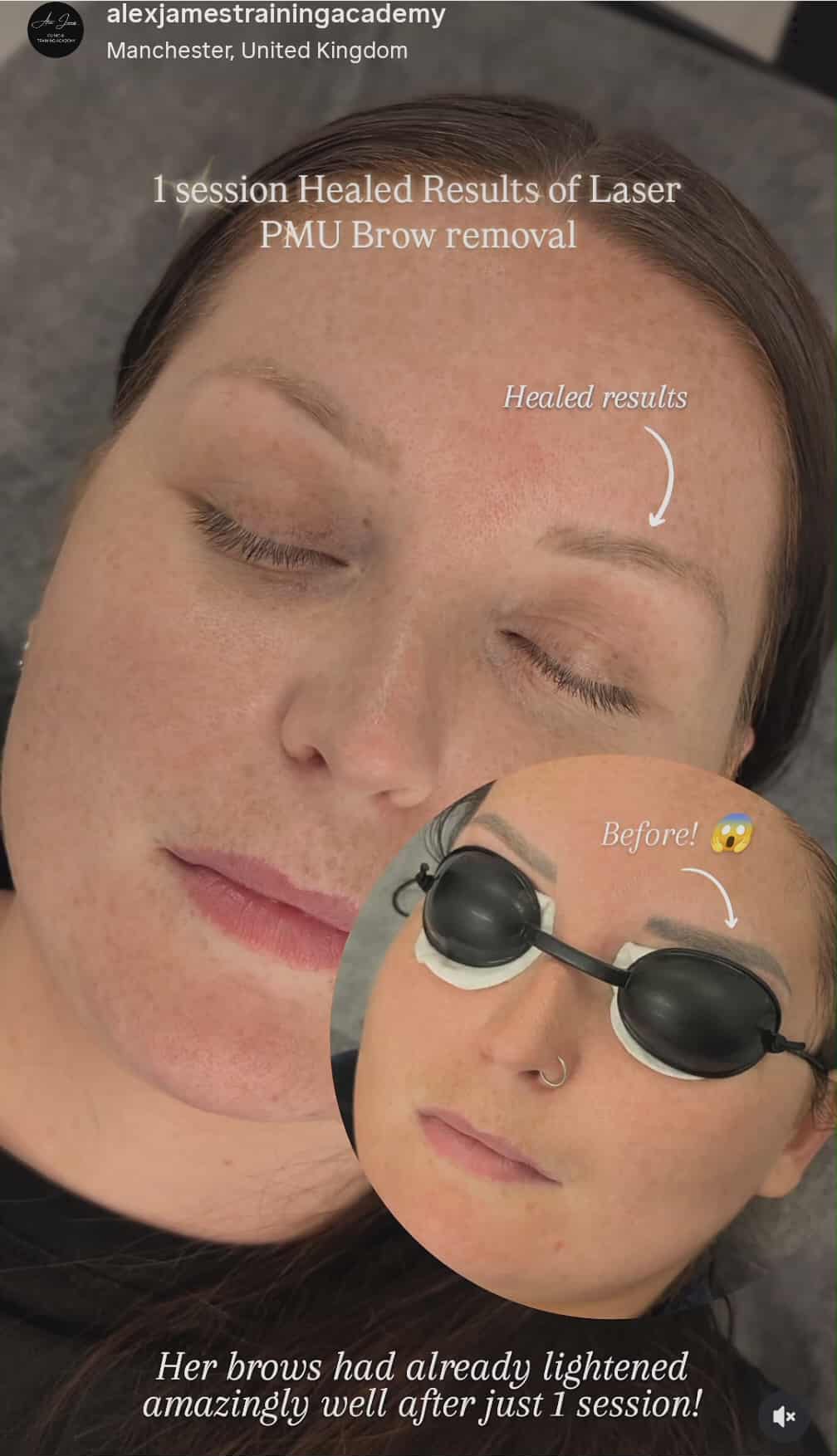
The brows begin to lose some of their visual weight. Sharp or blocky edges soften slightly. Strong warmth — reddish or orange tones — starts to reduce. Most of the progress during this phase is internal; the pigment is breaking down beneath the surface before you see major visible change. Many clients notice "a softness" around week two, or that their brows look less heavy in natural light.
This is when the majority of visible fading takes place. The brows look noticeably lighter, less blocked-out, and more natural. Unwanted undertones that previously dominated the face begin to recede. You may also see patchiness — which is a positive sign, not a problem. Brows fade in layers, so areas where pigment sat deeper may be slower to lighten. Patchiness is evidence the process is progressing correctly.
Most clients experience the biggest shift in how they feel about their brows after sessions two or three. The overall appearance softens dramatically. Harsh strokes blur or disappear. Unwanted undertones lift. The shape no longer overwhelms the eyes. Clients planning new PMU work often begin to feel ready at this point — the brows are starting to resemble a workable canvas.
Lightening for correction
Fading brows enough to allow new corrective PMU to sit, heal and colour accurately.
Softening for a natural look
Reducing density and harshness without fully removing the brows.
Full removal
A complete fresh start — particularly for older, heavily saturated or layered brows.
Preparing for new brows
Most PMU artists prefer brows faded 60–80% before applying new pigment.
Fading speed depends on how many pigment layers are present, whether the brows were microbladed, shaded or machine-implanted, the pigment brand and ingredients used, your individual immune response, and whether scar tissue exists from previous work. Some brows lighten beautifully within a few sessions; others require more. Neither is unusual — the goal is always steady, safe fading rather than speed.
What's normal, what's rare, and how to protect your skin
Immediately after treatment, temporary frosting (a white appearance) may appear on the brow area — this fades within minutes. Short-term redness, warmth and mild swelling are all normal. Darkening of the brows follows as the oxidation phase occurs. These are healthy, predictable responses that confirm the pigment has been targeted correctly.
Some clients develop tiny micro-scabs or slight dryness over the treated area a few days later, especially where brows were deeply saturated. A light itchiness during healing is common. Very occasionally a small blister may form in an isolated area where pigment depth was uneven — this heals cleanly when left alone and doesn't interfere with fading.
Temporary hyperpigmentation (skin darkening) can occur in clients who have recently tanned or don't follow sun protection guidance — it normally fades with time. Hypopigmentation (lighter patches) is much less common and usually temporary. Scarring from laser removal itself is extremely rare; it's almost always the result of picking at scabs or treating too aggressively. Conservative laser settings and proper session spacing keep this risk very low at our clinic.
Laser safety near the eyes
Your treatment is carried out using certified protocols, FDA-approved ND:YAG technology and medical-grade eye protection throughout. The brow area is one of the most commonly treated zones for PMU removal — when performed correctly by a trained specialist, risk of complications is low.
The first 48 hours are the most important. Avoid:
Staying well-hydrated and keeping generally healthy supports faster fading — your lymphatic system plays a significant role in how quickly pigment is flushed out after each session.
Ready to understand what's possible for your brows?
Visit our Laser PMU Removal service page for full treatment details, or WhatsApp us directly to book a consultation and patch test.
WhatsApp Us to BookFree consultation · Patch test included · Rossendale clinic
Professional, honest and genuinely committed to your result
Choosing where to have your brows removed can feel overwhelming — especially if you've had a disappointing PMU experience in the past. When pigment sits on your face, trust becomes the number-one factor. Clients consistently tell us they came to Alex James Clinic because they wanted somewhere professional, honest, and genuinely focused on achieving the best outcome without rushing the process or making unrealistic promises.
PMU removal behaves very differently from body tattoo removal. Brow pigments contain modifiers, warm and cool bases, titanium dioxide, iron oxides and often multiple layers from years of touch-ups. Understanding how these respond to laser is crucial for safe, effective fading. Because the clinic specialises in PMU removal rather than offering it as an occasional add-on, you benefit from knowledge built across many different pigment types, undertones and brow histories.
You're given a realistic picture of what can be achieved, how many sessions you're likely to need, and what results you should genuinely expect — including the things that may take longer or be harder to shift. Clients often say they feel relieved after their consultation because everything finally makes sense.
Although the clinic is based in Crawshawbooth, Rossendale, clients regularly travel from Rawtenstall, Burnley, Blackburn, Bury, Bolton, Preston, Accrington, Manchester and surrounding areas. The clinic location is easy to access, with no large city-centre traffic or parking difficulties. Many clients appreciate the privacy and calm of the setting — arriving relaxed rather than rushed.
What to expect from your first appointment
Your consultation is a detailed assessment, not a quick glance. You'll be asked about your brow history — the approximate age of your tattoo, whether it's been topped up, how the colour has changed. Your brows are then examined closely to identify undertones, saturation levels, pigment layers, symmetry, and any signs of scar tissue or deeper implantation. A patch test is carried out to confirm your skin responds safely to the laser. Most clients leave feeling genuinely informed about their brows for the first time.
Because every brow is different, pricing is based on the complexity of your pigment rather than a flat rate. Older brows with multiple colour corrections or dense shading require more work than brows microbladed once several years ago.
LASER PMU REMOVAL PRICING
£50 – £100 per session
Exact cost confirmed at consultation based on your brow assessment
Avoid sun exposure on the brow area in the weeks before your session. Refrain from strong active skincare ingredients near the brows, and avoid brow tinting or chemical treatments beforehand. These simple steps ensure your skin is in the best condition to receive treatment safely.
The brows are cleansed, protective eyewear is fitted, and cooling is used throughout. The laser session is quick and straightforward. Once complete, full aftercare instructions are provided and you have the chance to ask any questions. You're never rushed through the appointment.
LASER PMU REMOVAL · ROSSENDALE, LANCASHIRE
Book a free consultation at our Rossendale clinic. We'll assess your brows, explain exactly what's achievable, and give you an honest treatment plan with no pressure to commit.
WhatsApp Us for a Free ConsultationPHONE
LOCATION
538 Burnley Rd, Crawshawbooth, Rossendale BB4 8NE
Mon–Fri 9AM–4PM · Sat 9AM–12PM
