
MULTIPLE AWARD WINNING
2000+ HAPPY CUSTOMERS
LASER TRAINING · LANCASHIRE
Laser tattoo removal is one of the fastest-growing sectors in aesthetics. Demand has surged as tattoo culture has matured — more people who got inked in their 20s are now in their 30s and 40s looking for a way out, or wanting modifications. For beauty professionals looking to add a high-value treatment to their offer, laser tattoo removal is one of the most commercially attractive options available right now.
This guide walks you through everything you need to know: what the job actually involves day to day, what legal requirements apply in the UK, what training you should be looking for, what equipment costs, and what you can realistically expect to earn. Whether you're starting from scratch or adding to an existing aesthetics practice, the information here applies to you.
IN THIS GUIDE
The day-to-day reality of the role before you commit to training
A laser tattoo removal technician uses Q-switched or Nd:YAG laser technology to break down tattoo ink beneath the skin. The laser emits pulses of light at specific wavelengths that are absorbed by the ink particles — the energy shatters them into smaller fragments, which the body's immune system then gradually clears over the following weeks.
The job isn't just pointing a laser at skin. A good technician conducts thorough client consultations, assesses skin type and tattoo characteristics, selects appropriate wavelengths and settings, manages client expectations across a multi-session treatment plan, and handles aftercare guidance. Client communication is as much part of the job as the technical treatment itself.
In practice, most technicians work across a range of related treatments rather than tattoo removal exclusively. Laser PMU (permanent makeup) removal, SMP removal, and in many cases laser hair removal sit naturally alongside tattoo removal and use overlapping equipment. Building a broader laser offering significantly increases your earning potential and client base.
Tattoo removal is never a one-session process. Most tattoos require between 6 and 12 sessions to achieve significant fading or full removal, spaced 6 to 8 weeks apart to allow the skin to heal and the immune system to clear the fragmented ink. This means each client represents recurring revenue over a 12 to 24-month relationship — not a one-off transaction.
Why the recurring revenue model matters
Unlike many aesthetics treatments where a client comes once or twice, tattoo removal clients return consistently for a year or more. A modest client base of 20–30 active removal clients can generate substantial predictable monthly income — even before you factor in new enquiries. This makes it one of the stronger recurring-revenue treatments available in aesthetics.
Some laser tattoo removal technicians operate as employees within established clinics or salons. Most, however, work independently — either from a home treatment room, a rented clinic space, or a mobile setup. The equipment is self-contained and doesn't require significant premises modifications, which makes independent operation very accessible from a practical standpoint.
The legal requirements — and what's actually enforced
Yes — laser tattoo removal is a licensable activity in the UK under the Local Authority Licensing framework. If you intend to operate from a fixed premises (a salon, clinic, or treatment room), you are required to hold a Special Treatments or Skin Piercing licence from your local council. The specific name of the licence varies slightly between councils, but the requirement is consistent.
Licensing requirements typically cover the practitioner's training and competency, the safety of the premises, and the equipment being used. A reputable training course and a CPD certificate are the foundation of meeting these requirements — but you will still need to apply to your local authority separately.
Important: check with your local council before you begin
Licensing requirements and their enforcement vary between local authorities. Some councils are stringent; others less so. Before investing in equipment or booking clients, contact your local council's licensing department to confirm what's required in your area. Operating without the appropriate licence where one is required is a legal risk.
Alongside licensing, professional liability insurance is essential for any practitioner performing laser treatments. Most reputable insurers in the aesthetics space offer specialist laser treatment cover. Your insurer will typically require evidence of appropriate training before issuing cover — which is another reason choosing a credible, certificated course matters.
No — in the UK, laser tattoo removal does not require a medical qualification or clinical background. The majority of working technicians are beauty therapists, aestheticians, or career changers from unrelated fields. What matters is completing appropriate training and demonstrating competency. That said, having some background in skin anatomy, contraindications, and client care will always serve you well — good training courses cover all of this.
What the training actually covers and what to expect from a good course
A reputable laser tattoo removal training course should cover both the theory behind laser-skin interaction and hands-on practical technique. Theory without practical is not sufficient preparation for working on real clients — and practical without theory is how accidents happen.
Hands-on training should involve working on live models — not just mannequins or synthetic skin. You need to feel how the equipment responds, calibrate settings for different ink colours and depths, and practice the consultation process with real clients. A course that claims to qualify you for live client work without live model practice is cutting corners in the most consequential area.
Look for courses that are CPD certified. CPD certification means the course content has been assessed against a recognised standard. It's the primary credential your insurer and local authority licensing will expect to see, and it's what separates legitimate training from unregulated weekend courses with no external oversight.
At Alex James Training Academy
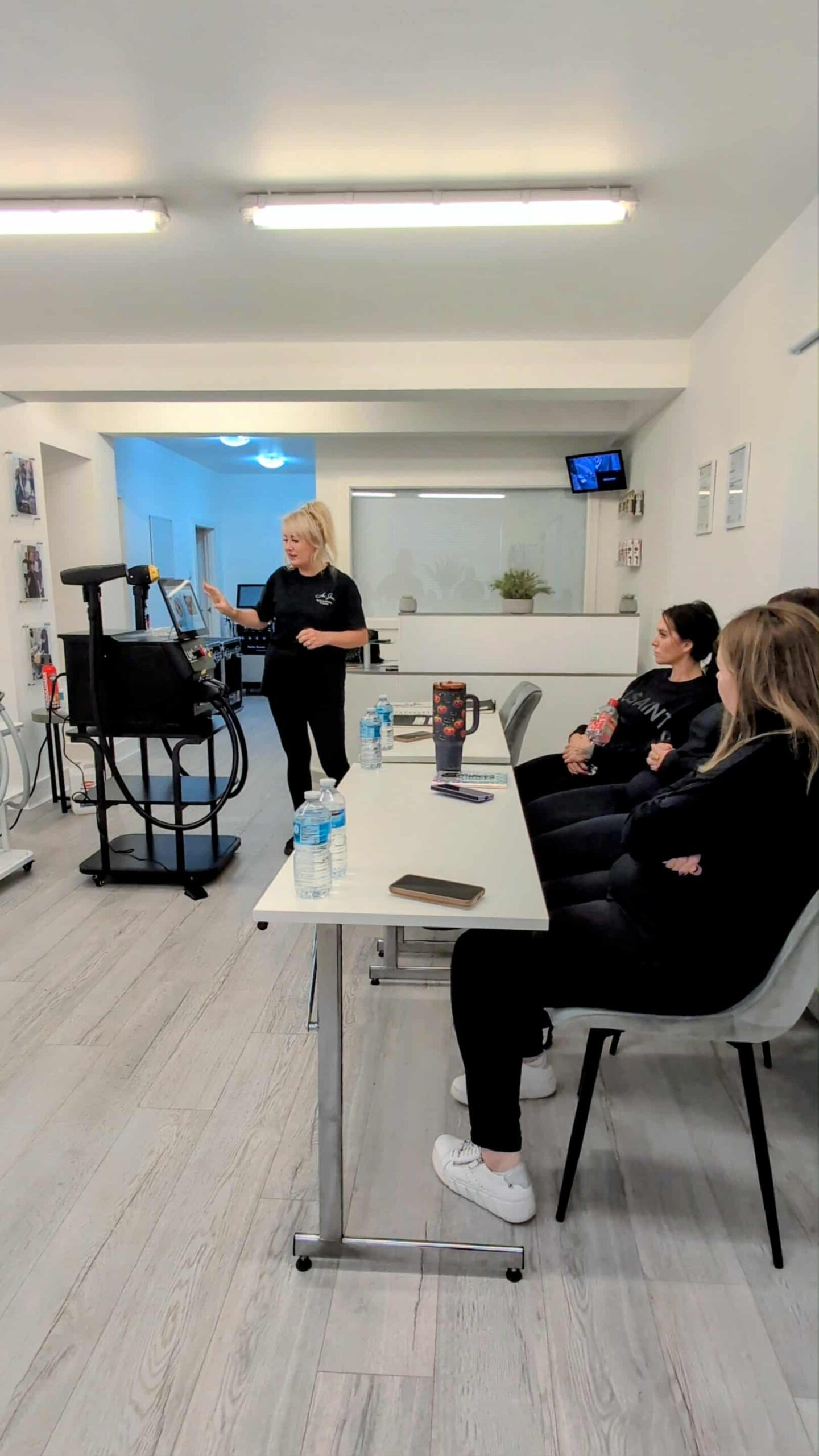
Our laser tattoo removal training course is CPD certified, includes full theory and hands-on practical training on live models, and is priced at £2,999 — covering everything you need to begin working on clients and applying for your local authority licence. Course dates are available throughout the year at our Rossendale training academy.
If you want to offer both laser tattoo removal and laser hair removal from the start, our dual laser training course covers both in a single programme. Most dual laser machines handle both treatments, so training across both disciplines from day one makes practical and commercial sense — you're qualified to use the full capability of your equipment immediately.
Interested in our laser tattoo removal course?
Get in touch to check upcoming course dates and ask any questions about the curriculum, equipment, or what to expect. We're happy to talk through whether the course is right for where you are in your career.
WhatsApp Alex to Find Out MoreCPD certified · Hands-on live model training · £2,999 all-inclusive · Rossendale, Lancashire
Red flags, green flags, and the questions to ask before you book
The laser training market is unregulated in terms of who can offer courses — which means quality varies enormously. There are excellent courses and there are courses that exist primarily to take your money. Knowing the difference before you book is important.
Ask the provider: Is the course CPD certified? How many live model sessions are included? What is the maximum group size? Is there post-course support? What equipment is used during training? What does the certificate state and will it be accepted by insurers? A confident, credible provider will answer all of these clearly without hesitation.
A note on course length
Laser tattoo removal cannot be covered properly in a single day. A thorough course typically runs over one to two full days — enough to cover theory in depth and complete meaningful practical time. Be cautious of courses claiming to deliver a full qualification in a half-day or single evening session.
Machine types, what to budget, and what actually matters when choosing
The laser machine is the core investment. For tattoo removal specifically, Q-switched Nd:YAG lasers are the industry standard — they operate at wavelengths of 1064nm (effective on dark inks) and 532nm (effective on red and warm-toned inks), and have an established safety and efficacy profile across all skin types.
Dual laser machines — which combine tattoo removal and laser hair removal in one unit — have become increasingly popular and represent better value if you intend to offer both services. You pay more upfront but avoid purchasing two separate machines, and dual systems from reputable manufacturers are built to handle clinical volumes across both treatment types.
ENTRY LEVEL
£3,000–£6,000
Compact Q-switched Nd:YAG machines. Suitable for building a client base. Lower shot counts may require more frequent servicing at higher volumes.
PROFESSIONAL
£8,000–£15,000+
Full-spec Nd:YAG or dual laser systems. Higher shot counts, better consistency, built for clinical volumes. The right choice if you're building a serious practice.
Wavelength range, pulse duration, spot size flexibility, and maximum fluence are the technical specifications that determine what a machine can treat and how effectively. Don't buy based on price alone — a cheap machine with limited wavelength options will restrict which tattoos and skin types you can work with, limiting your client base from day one.
After-sales support matters significantly more than it sounds. Laser machines require periodic servicing and occasionally repairs. A supplier with no UK-based support will leave you without a working machine — and without income — every time something goes wrong.
Finance options
Most equipment suppliers offer finance options that spread the cost over 24 or 36 months, making the upfront investment significantly more manageable for practitioners starting out. Factor the monthly repayment into your business plan rather than treating the full machine cost as a single barrier — at reasonable treatment volumes, a good machine pays for itself within the first year.
Realistic numbers — and what drives them
Treatment pricing for laser tattoo removal varies with tattoo size. The most common pricing structures in the UK:
| Tattoo size | Typical price per session (UK) | Sessions typically needed |
|---|---|---|
| Stamp / very small | £40–£70 | 4–8 |
| Small (palm-sized) | £70–£120 | 6–10 |
| Medium | £120–£200 | 6–12 |
| Large / sleeve sections | £200–£400+ | 8–15 |
A medium tattoo requiring 8 sessions at £150 per session generates £1,200 in revenue from a single client over the course of their treatment. Multiply that across a growing client base and the income potential becomes clear — particularly because you're building a pipeline of returning clients, not starting from zero each month.
A realistic picture of building a client base
Most practitioners start part-time alongside existing work and build their client base over 6–12 months before going full-time. Don't expect to replace a full income in the first few months — but equally don't underestimate how quickly a reputation for good results spreads in a local area. Tattoo removal referrals are extremely strong because results are visible and clients talk.
Running costs for laser tattoo removal are relatively low compared to the revenue generated. Your primary ongoing costs are consumables (gel, aftercare products, PPE), premises costs if applicable, machine servicing, insurance, and any continued professional development. Unlike injectables or chemical treatments, there's no expensive consumable per treatment that erodes your margins.
Honest criteria to assess before committing
Laser tattoo removal suits a specific kind of practitioner profile. If most of the following applies to you, it's likely a strong fit.
Beauty therapists and aestheticians with existing client relationships are well-positioned to add laser tattoo removal — you already have a base to market to, and your existing knowledge of skin and client care transfers directly. Tattoo artists looking to offer removal as a complementary service have a natural audience. Career changers with no aesthetics background can absolutely make this work too — the training is accessible and the barrier to entry is primarily financial, not academic.
The question we get asked most often
"Can I make a full-time income from this?" — Yes, but not immediately. The practitioners who've built the strongest businesses after training with us are those who started with a realistic 12-month plan, invested in good equipment, priced themselves fairly rather than racing to the bottom, and focused on delivering excellent results from the start. Good results generate referrals. Referrals build a practice.
Common questions from people considering laser tattoo removal as a career
Do I need a beauty therapy qualification to train in laser tattoo removal?
No. There is no prerequisite qualification required to undertake laser tattoo removal training in the UK. Courses are open to practitioners from any background, including those with no prior aesthetics training. What matters is completing a reputable, CPD-certified course and demonstrating practical competency — not what you studied beforehand.
How long does training take?
A thorough laser tattoo removal training course runs over one to two full days. This allows enough time to cover theory in depth and complete meaningful hands-on practical work on live models. Be cautious of any course claiming to deliver a comprehensive qualification in a single half-day — the practical element alone requires more time than that to be done properly.
Can I work from home as a laser tattoo removal technician?
Yes — many technicians work from a home treatment room. You'll need to check with your local council whether a home-based licence is available in your area, ensure your space meets any hygiene and safety standards required, and confirm your insurer is happy with a home-based setup. Most insurers are, provided the space is dedicated to treatment rather than a shared living area.
What's the difference between Q-switched and picosecond lasers?
Q-switched Nd:YAG lasers deliver energy in nanosecond pulses and are the industry standard for tattoo removal — proven, widely used, and effective across the full range of common ink colours. Picosecond lasers deliver shorter pulses and are marketed as faster and more effective on stubborn inks, but cost significantly more. For a practitioner starting out, a quality Q-switched machine is the practical and financially sensible choice — picosecond technology is an upgrade for an established, high-volume practice.
Is there demand for laser tattoo removal in smaller towns and cities?
Yes — often more so than in major cities, where the market can be saturated. Smaller towns frequently have few or no local laser tattoo removal providers, meaning clients currently travel significant distances for treatment. Establishing yourself as the local specialist in an underserved area is a strong starting position. The demand is driven by the age profile of the tattooed population — which exists everywhere equally.
Can I also train in laser hair removal at the same time?
Yes — and it makes strong commercial sense to do so. Laser hair removal uses overlapping technology and is one of the most in-demand aesthetic treatments in the UK. Our dual laser training course covers both tattoo removal and hair removal in a single programme, meaning you're qualified to offer both treatments from the moment you complete training and invest in a dual-capable machine.
ALEX JAMES TRAINING ACADEMY · ROSSENDALE, LANCASHIRE
Our CPD-certified laser tattoo removal course covers everything you need to begin working on clients — full theory, hands-on live model practical, and post-course support. Get in touch to check upcoming dates.
WhatsApp Alex to Find Out More