Alex James SMP

microblading removal Alex James Clinic in Manchester

What Microblading Removal Is, Why It’s Needed & How Brow Pigments Behave Over Time

Microblading and semi-permanent eyebrow tattooing have transformed the way people frame their faces. As techniques grew in popularity — microblading, ombré brows, powder brows, machine brows, hybrid techniques — many clients experienced a dramatic improvement in brow symmetry, density and convenience. However, as trends shift and pigments evolve, it’s increasingly common for people to seek microblading removal to correct old, discoloured or poorly healed eyebrow tattoos.

At Alex James Clinic in Rossendale, Lancashire, we specialise in laser eyebrow tattoo removal, offering a safe, effective and controlled way to fade or completely remove unwanted pigment. Clients travel from Manchester, Bury, Burnley, Blackburn, Preston, Bolton and across the North West because they want a professional, honest and knowledgeable approach — especially when the treatment involves their face.

Microblading removal isn’t simply about erasing a brow. It’s about giving clients back control of their appearance and helping them feel confident again, whether they want a fresh set of brows, a softer look, or a clean slate.

Table of Contents

Why Microblading Removal Has Become So Popular

Although marketed as “semi-permanent,” microblading rarely fades evenly or predictably. Many people find that the brows they loved during their first year gradually become something very different over time. Pigments behave unpredictably, techniques vary from artist to artist, and the skin itself changes. What was once crisp and well-shaped can become blurred, warm-toned, greyish, uneven or simply out of sync with your current style.

One of the most common reasons clients request removal is pigment colour change. A large percentage of microblading and PMU pigments contain iron oxides or titanium dioxide. These ingredients help create natural-looking brow shades initially, but as the pigment degrades in the skin, colours may shift. A warm brown can turn orange or red. Cool browns may heal ashy, grey or even blue. These shifts don’t always reflect poor technique — sometimes they’re simply the natural evolution of PMU pigment.

Another frequent motivation is shape. Brow fashions evolve quickly, and what felt right several years ago may now appear too rounded, too square, too thick or even too high. Some clients never felt their brows suited their face, but felt unsure where to go for help. Others had brows implanted too deeply, causing strokes to blur prematurely or remain stubbornly saturated for years.

As PMU gained popularity, so did cases of inexperienced artists performing treatments. Many clients come to us with brows that healed unevenly, with asymmetry, muddiness, overly compressed strokes, or harsh machine shading. Some brows heal with a reddish or purple tone due to incorrect colour selection. Others contain multiple layers of pigment from repeated top-ups, which creates a dense, shadowy appearance that no longer resembles microblading at all.

Microblading removal offers a solution for all of these concerns — whether you want to fully remove the brows, lighten them to prepare for corrective work, soften the appearance, or simply remove excess density.

Understanding Microblading: How Pigment Sits in the Skin

To appreciate how removal works, it’s helpful to understand where microblading pigment lives inside the skin. Unlike body tattoos, which penetrate deeper into the dermis, microblading is designed to sit in the upper layer of the dermis so that it fades over time. In theory, this should lead to natural softening — but pigment rarely fades uniformly.

Factors such as depth of implantation, pigment formulation, skin type, and previous corrections all influence how the brows age. A client with multiple pigment layers from repeated touch-ups will have a very different removal journey from someone who had a single microblading session years ago.

Because the brows sit on a highly expressive part of the face, the skin around the eyebrows undergoes constant movement. This can cause pigment to spread microscopically over time, changing the crisp hair-stroke effect into a smudge or haze. Clients often say their brows “blurred,” “faded strangely,” or “don’t look like hair strokes anymore.” This is a normal evolution of old PMU pigment.

Your natural skin undertone also plays a role. Warm undertones may push pigment into a reddish zone as it breaks down. Cooler undertones may cause brown pigments to appear grey or blue. None of these changes can be fixed by simply adding more pigment — in fact, layering more PMU often leads to deeper, more stubborn discolouration.

This is where laser eyebrow tattoo removal becomes the most effective solution.

How Pigments Change Over Time — And Why They Often Need Removal

Eyebrow pigments are made from a combination of iron oxides, organic colourants and, in many cases, white-based pigments such as titanium dioxide. These ingredients help create natural shades initially, but they also break down in distinctive ways.

Iron oxide pigments, for instance, oxidise as they degrade. This is why some brows shift toward red, orange or even salmon tones. Clients often describe this as their brows “warming up” dramatically. Meanwhile, pigments with a carbon base tend to fade grey or ashy. Titanium dioxide, which is used to add opacity, can cause pigment to resist fading and sometimes darken temporarily during laser treatment.

If a client has had PMU done by multiple artists over the years, each using different pigment brands or colours, the brows may contain several layers of varying undertones. This is why some brows appear patchy or “muddy,” especially under natural light. Removing these layered pigments helps restore clarity and gives corrective brow artists a clean, workable base.

For some clients, microblading fades naturally to a soft shadow. For others, particularly those with deeper strokes or machine shading, the pigment remains for many years — and becomes harder to ignore. Microblading removal provides a controlled way to reverse these changes and restore harmony to the face.

Laser pmu removal treatment in progress Alex James Manchester clinic

Why Laser Is the Preferred Method of Eyebrow Tattoo Removal

When clients first research brow removal, they often hear conflicting opinions about laser and saline. While both methods have their place, laser is widely considered the safest and most predictable for eyebrow tattoo removal when performed correctly.

Laser removal works by precisely targeting pigment molecules beneath the skin using controlled light energy. The pigment absorbs the laser’s energy more quickly than surrounding tissue, causing the particles to shatter into smaller fragments. The immune system then gradually flushes these out over weeks. This makes laser a non-invasive method compared to saline, which involves breaking the skin surface to lift pigment out manually.

Laser removal is ideal for discoloured brows, overly saturated brows, blurred strokes, or residual PMU from multiple sessions. It’s also excellent for preparing the skin for new brows. Many PMU artists refuse to work over pigment that’s too dense or too dark — laser removal allows the new shape and colour to sit correctly and heal beautifully.

When performed by a trained practitioner using appropriate ND:YAG settings, laser removal is gentle on the skin and does not damage brow hairs. Clients are often relieved to learn that their natural brow growth is unaffected. This is especially important for clients who rely on their natural hair for shape guidance.

Laser is also highly effective for the warm reds, oranges and greys that older microblading leaves behind. These tones often respond faster and more consistently to laser than to saline, particularly when the pigment sits deeper in the dermis.

Who Chooses Microblading Removal?

Clients seeking brow tattoo removal range from those with very subtle faded pigment to those with deeply saturated brows that no longer resemble microblading. Common scenarios include people who feel their brows healed too dark, too cool, too warm, too flat or too heavy for their face. Others feel their brows distort their expressions or no longer suit their age or style.

Some clients simply want a fresh start — perhaps they had microblading done five or six years ago when techniques were different, and they now want a softer, more natural brow. Others want removal so they can transition from microblading to machine shading, switch to a different artist, or correct long-standing asymmetries.

Many clients also come to the clinic after trying to live with their brows for years, hoping they would fade naturally. When they don’t, laser removal provides the reassurance that change is possible.

Whatever the reason, clients consistently describe a sense of relief once they see their brows beginning to fade. It often feels like lifting a visual weight off the face.

Location: Who We Serve

Although many clients are local to Rossendale, Crawshawbooth and Rawtenstall, people regularly travel from Manchester, Burnley, Blackburn, Bury, Bolton, Preston and across Lancashire for microblading removal. Our clinic’s approachable and professional atmosphere — combined with specialised knowledge in PMU removal — attracts clients seeking safe, ethical and honest treatment. For further information on removal and book a potential consultation & patch test click below.

eyebrow tattoo removal at Alex James Clinic in Lancashire

How Laser Eyebrow Tattoo Removal Works: The Complete Client Guide

Removing unwanted microblading or eyebrow tattoo pigment can feel daunting, especially if you’re unsure how the laser actually works or what happens to the pigment in your skin. This section is designed to give you a clear, reassuring and realistic understanding of the removal process, what the laser does beneath the surface, and what you can expect at each stage of treatment.

At Alex James Clinic, you’re not expected to arrive with any prior knowledge. You’ll always be talked through the process step-by-step during your consultation, but this section will give you a strong foundation so you feel confident and informed from the start.


Understanding How Laser Eyebrow Tattoo Removal Targets Microblading Pigment

Microblading pigment sits in the upper layers of the dermis — deeper than makeup, but not as deep as a traditional body tattoo. The challenge is that this pigment doesn’t fade evenly on its own, and the colours can shift over time. Laser removal works by sending pulses of light into the skin that specifically target the pigment, not the surrounding tissue.

The energy is absorbed by the unwanted brow pigment more readily than by the surrounding skin. This difference in absorption allows the laser to break the pigment particles apart without damaging your skin barrier. Once the pigment has been shattered into smaller fragments, your body gradually flushes these particles away through your lymphatic system over the following weeks.

It’s a safe, controlled and predictable method — especially when carried out by someone who specialises in PMU pigment removal, not just general tattoo removal.


Why Your Brows May Look Darker Before They Look Lighter

One of the most important things to understand is the oxidation effect. It’s completely normal — and expected — for your brows to darken immediately after treatment. This temporary colour change isn’t a sign of damage or incorrect laser settings. Instead, it’s a chemical reaction between the laser energy and certain pigments, especially those containing iron oxide or titanium dioxide (common ingredients in older or modified brow pigment formulas).

This darkening phase typically settles within a few days. As the pigment begins breaking down internally, your brows gradually lighten and soften. Many clients feel nervous the first time they see the darkening, but once they understand why it happens, the process becomes far less intimidating.

The darkening is actually a good sign that the pigment is responding correctly, and we always explain this clearly during your consultation so you know exactly what to expect.

What Happens During Your Laser Brow Removal Appointment

Your treatment experience is designed to be calm, comfortable and efficient. When you arrive, your skin will be cleansed, and you’ll be given protective eye shields for safety. The laser pulses are then applied gently across the brow area, with cooling used before, during and after treatment to reduce heat sensation.

Most clients describe the feeling as a quick, warm flicking sensation — much easier than having the brows tattooed in the first place. The treatment itself usually takes just a few minutes per brow, although the full appointment also includes preparation, aftercare discussion and a chance to ask any questions.

You’ll notice some frosting (a temporary white appearance) in the treated area immediately afterward; this is completely normal and fades within minutes. Mild redness or swelling may follow, which is simply the skin reacting to the heat and will settle quickly.

From start to finish, the appointment is straightforward, and you’re always kept fully informed throughout the process.

How the Laser Knows Which Pigment to Target

You may wonder how the laser can distinguish between your brow pigment and the surrounding skin. The ND:YAG laser used at Alex James Clinic operates at specific wavelengths that are highly attracted to pigment molecules. These wavelengths are selected because they’re effective on the types of pigments commonly used in microblading and semi-permanent brows.

Different pigment colours respond differently. Carbon-based blacks and greys generally break down more quickly. Warm tones such as red, orange or pink also respond well but may show that temporary oxidation effect. Titanium dioxide (white component in some pigments) can take a little longer, but the laser still breaks it down safely with repeated sessions.

Because the wavelengths pass through your natural brow hairs without being absorbed, the laser does not damage or remove your brow hair — something clients often worry about unnecessarily.


Why Treatment Spacing Matters for Safe, Effective Fading

Laser removal is not a procedure that should be rushed. Although the laser shatters the pigment instantly, the fading you see happens over several weeks as your body naturally processes and flushes the pigment fragments away.

This is why sessions must be spaced six to ten weeks apart. Your skin needs time to heal, and your immune system needs time to carry out its part of the process. Treating too soon risks irritation without improving results, and a responsible practitioner will always prioritise skin integrity over speed.

You may see fading within the first couple of weeks, but deeper pigment continues to break down long after the appointment. Many clients are surprised to see their brows continue lightening at the eight-week mark.

Giving the body room to do its job ensures your results develop consistently and safely across sessions.


Why Each Person’s Brows Fade Differently

Even with the same laser and the same number of sessions, no two clients fade in exactly the same way. Pigment clearance depends on a variety of factors, including the pigment brand originally used, how deeply it was implanted, whether the brows have been touched up multiple times, and your individual immune response.

If your brows contain older pigment or multiple colour corrections, you may notice patchiness early on. This is completely normal. Brows fade in layers, not evenly across the whole brow at once. Areas where the pigment was deeper or where the skin has scar tissue may take longer to respond.

By the third or fourth session, most clients begin to see their brows softening, brightening, and losing the harsh definition or discolouration that made them feel uncomfortable.

Is Laser Brow Removal Painful? What Does It Feel Like?

Pain levels vary from person to person, but most clients find laser eyebrow tattoo removal surprisingly manageable. Many describe it as a warm snapping sensation, comparable to plucking several hairs at once. The treatment is fast, and cooling is used throughout to minimise discomfort.

For clients who are anxious or sensitive, the reassurance tends to be immediate as soon as the first few pulses are delivered. The majority say the anticipation is far worse than the treatment itself.

Your comfort is always the priority, and treatments are kept controlled, steady and gentle.

PMU brow removal Alex James Clinic

Understanding Laser Safety on the Face

It’s important that clients feel safe, especially when a laser is being used near the eyes. Your treatment is carried out using certified protocols, FDA-approved ND:YAG technology and medical-grade eye protection. The brow area is one of the most commonly treated zones for PMU removal, and when performed correctly by a trained specialist, the risk of complications is low.

The laser energy is highly specific to pigment absorption, meaning it does not “burn” or remove layers of skin. It passes harmlessly through the epidermis to reach the pigment in the dermis. This targeted behaviour is what makes laser removal such a precise and controlled method for fading microblading.

Everything is carried out with a gentle, skin-first philosophy — the effectiveness of the removal is always balanced with protection of your natural skin and brow hair.


Why Laser Is Chosen Over Saline Removal for Eyebrows

While saline removal can be appropriate for certain types of PMU or small corrections, it requires breaking the surface of the skin to lift pigment out. This can lead to more scabbing and a higher risk of texture changes, especially in sensitive facial areas like the brows.

Laser removal avoids this by working internally. It leaves the surface of the skin intact, produces minimal downtime, and is ideal for the common problems clients face with microblading: discolouration, saturation, blurring and undertone issues.

Because your treatment is carried out with ND:YAG technology specifically supportive of PMU removal, clients benefit from predictable fading, minimal trauma and lower risk.

Microblading Removal Results: What You Can Expect to See After Each Session

One of the most reassuring parts of the microblading removal journey is understanding how your brows are likely to look as they fade. While every client responds slightly differently, there is a very consistent pattern in how pigment breaks down and how the brows change from the first treatment to the final result. This section will help you understand what “normal” looks like, what fading stages you’ll experience, and why the process requires patience to achieve the best possible outcome.

For many clients, simply knowing what to expect brings huge relief — especially after months or years of frustration with unwanted PMU.


How Your Brows Change Immediately After Treatment

Right after your laser session, you’ll see several temporary changes that are all part of a healthy response. A frosted or powdery appearance may show briefly on the skin; this usually fades within minutes. Your brows may look slightly raised, warm, or pink in the surrounding area. For some people, swelling appears lightly across the brow line, especially if the original pigment was dense.

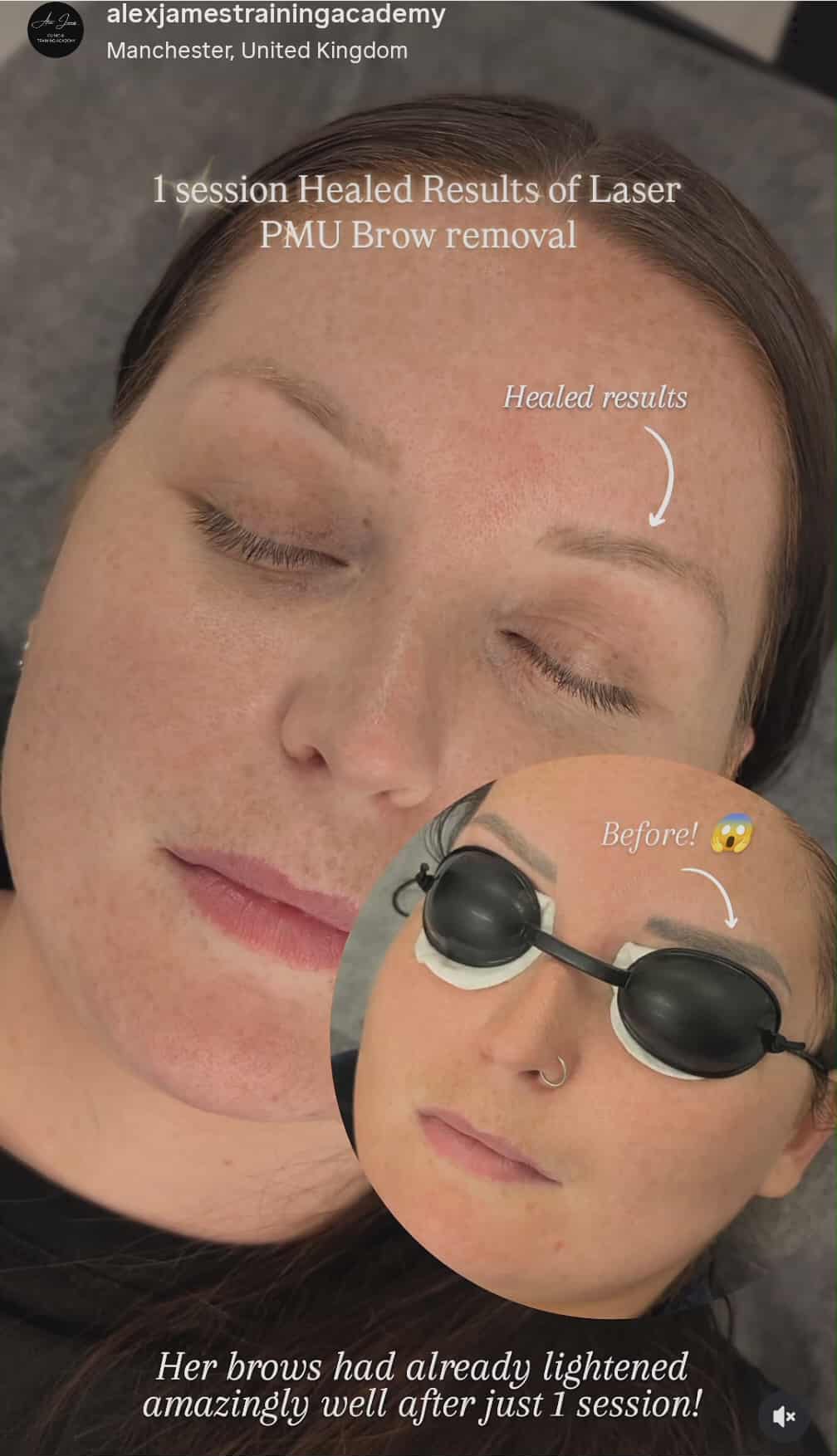
Most clients notice the most dramatic change within the first hour: the brows appear darker. Although this can feel surprising, it is one of the clearest signs that the pigment has reacted correctly to the laser. As explained in the previous section, oxidation temporarily deepens the colour. This stage doesn’t last long — usually a couple of days — and does not reflect the final result. Once the oxidation subsides, the true fading process begins internally.

You can continue your day as normal after treatment, and there is no need to hide away. Apart from avoiding sweat, heat and makeup for the first 48 hours, your routine will stay largely unaffected.


The First Two Weeks: Early Fading and Softening

In the first couple of weeks, the most noticeable changes tend to be subtle. The brows begin to lose some of the visual weight they once had. Edges that previously looked sharp or blocky soften a little. Any strong warmth, such as reddish or orange tones, starts to reduce. Grey or ashy brows often begin to look lighter and less dense.

Because pigment breaks down below the surface before you see major changes on top, this early stage is mostly internal progress that will become more visible later. Many clients say they suddenly notice “a softness” around week two, or that their brows look less heavy in natural lighting.

This is the stage where you may see some mild dryness or flaking in tiny areas if the pigment was particularly dense — this is normal and should never be picked at.


Weeks Four to Ten: The Most Noticeable Phase of Fading

This is the period when the majority of visible fading takes place. Your body has had enough time to flush away a significant portion of the shattered pigment particles, and the brows begin to look visibly lighter.

Clients often describe this as the stage where their brows:

  • Look less “blocked out”

  • Feel less dominant on the face

  • Show more skin tone coming through

  • Appear more natural and less harsh

  • Have lost the heavy undertones that bothered them

You might also see what many clients refer to as “patchiness” — but this is a very positive sign. Each session breaks down pigment in layers, not evenly across the entire brow. Areas that were tattooed deeper may take longer to fade, while lighter strokes may clear more quickly. Patchiness is simply evidence that the fading is progressing, not that something is wrong.

By the time you reach week six or eight, your brows are usually healed enough to safely have another session if needed. This timing ensures the skin remains healthy and the fading continues evenly.


After Two to Three Sessions: A Turning Point in Most Journeys

Most clients experience the biggest sense of relief after their second or third session. This is typically when the brows shift from “improved” to “noticeably changed.” The overall appearance softens dramatically, and the unwanted tones or shapes that once dominated the face begin to recede.

If you’ve been living with brows that feel too dark, too saturated or too uneven, this is the point at which clients often say they feel like they’ve “got their face back.” You may find that:

  • Harsh strokes are significantly blurred or gone

  • Any unwanted red, grey or blue undertones have lifted

  • The brows sit more naturally with your features

  • The shape no longer overwhelms the eyes

  • Makeup blends more easily over the brows if needed

Clients who are planning new PMU work often begin to feel excited at this stage, as the brows start to resemble a clear canvas rather than a correction challenge.


When Brows Are Ready for New Microblading or Correction Work

Although many clients choose full removal, others simply want their brows lightened enough to start fresh with a new artist or a different brow technique. If this is your goal, your brow technician will assess the fading after each session to determine when you’re ready.

Most artists prefer to work over brows that are faded by at least 60–80%. At this level, the new pigment can sit cleanly on the skin without mixing visually with old undertones. This results in:

  • A clearer colour outcome

  • A more defined and accurate shape

  • Better healed results

  • Longer-lasting satisfaction

We always encourage clients to avoid rushing into new brows too soon. Giving the skin time to heal fully and ensuring old pigment is adequately faded are essential for the best long-term results.

Full Removal vs. Lightening: What Outcome Should You Expect?

It’s important to distinguish between lightening and complete removal. Many clients only require lightening, and this often takes fewer sessions — especially when the goal is simply to correct the brow shape or colour.

Full removal requires more time because older pigments, deeper strokes or brows that have been topped up repeatedly will contain multiple layers of pigment. These layers must fade gradually to preserve the health of the skin.

People seeking total removal often notice a soft “shadow” stage at some point in the process. This stage is temporary and reflects deeper pigment breaking down; with subsequent treatments, this soft shadow clears further.

Overall, most clients fall into one of three categories:

  • Lightening for correction

  • Softening for a more natural look

  • Complete removal for a fresh start

Your journey will depend on your goals, your pigment history, and how your skin responds to each session — all of which are discussed in detail at your consultation.


Why Some Brows Take More Sessions Than Others

It’s completely normal for clients to compare their results to friends or online examples, but every set of brows is different. The speed and completeness of fading depend on factors such as:

  • How many layers of pigment you have

  • Whether the brows were originally microbladed, shaded, or machine implanted

  • The pigment brand and ingredients used

  • Your individual immune system response

  • The presence of titanium dioxide or colour corrections

  • Any scar tissue from previous work

  • Your skin type and general health

Some brows lighten beautifully within a few sessions, while others require more work — neither is unusual. The goal is always strategic, steady, safe fading, not aggressive or rushed sessions.


Seeing Past Brows Fade Can Be an Emotional Experience

For many clients, the journey is not just physical. Your brows shape your entire expression, and unwanted pigment can affect self-esteem more than people realise until they see the change begin. It’s common for clients to say they wish they had started the process sooner, or that they finally recognise their own face again as their brows begin to lift and soften.

This emotional relief is a big part of why microblading removal has become so empowering for so many people. It isn’t just about aesthetics — it’s about confidence, comfort and feeling like yourself again.

Understanding Safety in Microblading Removal and How Your Skin Responds

Safety is the most important part of your microblading removal journey. When you’re considering laser eyebrow tattoo removal, it’s completely natural to worry about discomfort, risks or how your skin will react — especially when the treatment is on such a visible area of the face. This section guides you through what is normal, what is rare, and how we keep your skin protected at every step.

At Alex James Clinic, every decision is made with your comfort and long-term skin health in mind. From conservative laser settings to safe treatment intervals and thorough aftercare support, you’re looked after from the moment you walk through the door to the moment your results are complete.


What Side Effects You Can Expect After Laser Brow Removal

Most clients experience very mild, temporary reactions after laser treatment. These responses simply show that the pigment has been activated and the skin has reacted as expected. Immediately after treatment, it’s common to notice a temporary white or frosted appearance on the brows. This fades within minutes and is part of the thermal reaction between the laser energy and the pigment.

Short-term redness and a feeling of warmth are also normal. Some people experience mild swelling, especially if their brows originally contained dense pigment. These reactions usually settle within a few hours, although for some clients the mild warmth or pinkness may linger into the next day. Darkening of the brows, as explained previously, is also expected during the oxidation phase and is not a sign of a negative reaction.

These are healthy, predictable responses that signal the pigment has been targeted successfully — nothing more.


Less Common But Still Normal Reactions

Although most clients experience very mild reactions, there are a few responses that can appear occasionally. Some individuals develop tiny micro-scabs or slight dryness over the treated area a few days later, especially if their original brows were deeply saturated. Others may notice a light itchiness as the skin heals, much like the feeling of dry skin. These subtle changes are normal and resolve on their own as long as you avoid scratching or picking.

A very small number of clients may develop a small blister in an isolated area, usually where pigment depth was uneven. This heals cleanly when left alone and does not interfere with fading.

Your skin should never feel damaged, overly hot, or painful for prolonged periods. If anything feels unusual, you can always reach out for reassurance.


Possible Risks and How They Are Minimized

Although laser eyebrow tattoo removal is considered very safe, it is important to be aware of potential risks — even if they are rare. Understanding them helps you feel more in control, and it also highlights why choosing a trained, experienced practitioner is essential.

One of the more common risks is temporary hyperpigmentation, where the skin temporarily darkens after treatment. This normally occurs in clients who have recently tanned, or in those who do not follow sun protection guidance. The good news is that this effect usually fades with time. You can greatly reduce the risk simply by keeping the area away from UV exposure for several weeks before and after treatment.

Hypopigmentation — where the skin appears lighter — is much less common and usually temporary. It is more likely to occur if the brows are over-treated elsewhere or if the skin is compromised, which is why we always take a cautious approach and allow enough time between sessions.

The risk clients worry about most is scarring. In reality, laser removal itself does not scar the skin when used correctly. Scarring is almost always the result of picking at scabs, treating the area too aggressively, or having brows tattooed too deeply in the past. By using conservative energy settings and prioritising your skin integrity above speed, the risk of scarring at our clinic is extremely low.

PMU removal Alex James Clinic in Manchester

Why Laser Brow Removal Is Safer Than Many Alternatives

It’s helpful to understand why laser removal is generally preferred over methods such as saline removal — especially for brows. Saline removal requires breaking the skin to push pigment outward. While this can be suitable for certain corrections, it often involves heavier scabbing and a higher risk of textural changes on delicate facial skin.

Laser removal, on the other hand, works beneath the surface without disturbing the top layer of skin. There is no cutting, scraping or chemical exposure, and the healing process is significantly more predictable. It also makes it suitable for clients who want minimal downtime and a method that doesn’t leave visible marks as it heals.

Because the brow area is so expressive and so central to the face, choosing the safest method is essential. This is why laser remains the preferred option at our clinic.


How Your Skin Heals After Each Session

Your skin begins healing immediately after treatment. Most clients feel completely normal within a few hours, with the only visible change being the temporary darkening of the pigment. Over the next few days, the skin gradually settles and any pinkness fades.

As the internal healing continues, the pigment gradually breaks down and your brows begin to lighten. You may not notice visible fading until around the second or third week, but internal changes happen long before that. If your brows become slightly uneven or patchy during this time, this is simply the pigment breaking down in layers — a normal part of the process.

Complete surface healing usually takes around one to two weeks. Internal fading continues for many more weeks, which is why proper spacing between treatments is so important.


How Aftercare Protects Your Skin and Enhances Your Results

Following aftercare correctly is one of the simplest ways to protect your skin and speed the fading process. The first 48 hours are the most important: you’ll want to avoid moisture, heat, sweat, saunas and makeup around the eyebrow area. This allows the skin barrier to settle without irritation.

It’s important not to pick at any dryness or tiny scabs that form. Even the smallest areas of interference can delay healing or leave a mark. Keeping the area clean, dry and protected is usually all that’s needed in the early days.

Beyond this, you should avoid active skincare ingredients — such as retinoids or acids — on or near the brows until the skin is fully healed. Sun protection is essential for the entire duration of your removal journey. UV exposure can cause pigment darkening or slow fading, and it increases the risk of temporary hyperpigmentation.

Avoiding brow tinting, henna, lamination, or any chemical brow treatments ensures the skin remains undisturbed throughout the process. Once the skin is fully healed, your normal routine can be resumed.


Factors That Influence Healing Speed and Fading

Even if two clients receive identical treatments, their healing and fading speeds may be very different. Your body’s immune system plays a major role in how quickly pigment is flushed out. Clients who are well-hydrated, active, and healthy often see faster fading simply because their lymphatic system is more efficient.

Other factors such as pigment density, the presence of titanium dioxide, previous colour corrections, scar tissue from earlier PMU work, and the number of historical brow tattoo sessions can also influence how long the process takes.

This is why we approach every case as unique. Your progress will be monitored at each session, and recommendations will be tailored specifically to the way your brows respond.


When to Get in Touch During the Healing Process

We always encourage clients to reach out if they have any concerns at all during healing. While complications are extremely rare, peace of mind is important. If you experience unusual discomfort, prolonged redness, or a reaction that doesn’t seem to be settling, you can contact us anytime. Most concerns can be resolved quickly with reassurance or simple advice.

Knowing that support is available throughout your journey helps many clients feel more relaxed and confident as they go through the fading process.

To register your interest and ask any questions you may have, visit our dedicated Laser PMU Removal page using the button below.

Why Clients Choose Alex James Clinic for Microblading Removal

Choosing where to have your brows removed can feel overwhelming, especially if you’ve had a disappointing PMU experience in the past. When pigment sits on your face, trust becomes the number-one factor in choosing a clinic. Clients often tell us they came to Alex James Clinic because they wanted somewhere that feels professional, safe, honest and genuinely committed to achieving the best outcome for their brows — without rushing the process or making unrealistic promises.

What many people appreciate most is that your experience isn’t treated like a “quick fix.” Your brows are handled with care, patience and transparency. You’re given clear information about what can be achieved, how your brows are likely to fade, and what your skin needs to stay healthy throughout the process. There is no pressure to book additional treatments, and your journey is tailored to your individual brow history, goals and pigment behaviour.

Clients regularly comment on how reassuring it feels to be heard, understood and supported — not judged or rushed. For many people, that alone makes the biggest difference.


A Specialised, Client-Centred Approach to Brow Tattoo Removal

You’re never treated as “just another client.” Microblading removal is a highly individual process, and your brows, your pigment history and your skin response are treated with careful consideration. Because the clinic specialises in PMU removal rather than offering it as an occasional add-on, you benefit from knowledge that comes from working with many different pigment types, undertones and techniques.

This experience matters. Brow tattoo removal behaves differently than body tattoo removal. PMU pigment contains modifiers, warm and cool bases, titanium dioxide, iron oxides and often multiple layers from years of touch-ups. Understanding how these respond to laser is crucial for achieving safe and effective fading.

You’re given honest guidance from the start — including whether your brows can be fully removed, how many sessions you’re likely to need, and what results you should realistically expect. Clients often say they feel relieved after their consultation because everything finally makes sense.


Local Expertise for Clients Across Lancashire and the North West

Although the clinic is based in Crawshawbooth (Rossendale), clients travel from across Lancashire and Greater Manchester for microblading removal because they want specialist care rather than a general beauty appointment. Many of our visitors come from Rawtenstall, Burnley, Blackburn, Bury, Bolton, Preston, Accrington, Manchester and surrounding North West areas.

The clinic location is intentionally convenient — easy to access, without the stress of large city-centre traffic or parking difficulties. Many clients say they appreciate the privacy and calmness of the setting, knowing they can arrive feeling relaxed rather than rushed.

If you’ve struggled to find a trustworthy place near you for eyebrow tattoo removal, you’ll likely find the journey worthwhile once you experience the clinic’s atmosphere and approach.

What Happens During Your Consultation

Your consultation is an important part of the process. It’s not simply a quick glance at your brows — it’s a detailed assessment that helps determine the safest and most effective approach for your specific situation. You’ll be asked about your brow history, the approximate age of your tattoo, whether it has been topped up over the years, and how the colour has changed over time.

Your brows are then examined closely to identify undertones, saturation levels, pigment layers, symmetry and any signs of scar tissue or deeper implantation. This allows a realistic treatment plan to be created specifically for you. A patch test is also carried out to ensure your skin responds safely to the laser.

Many clients feel a sense of relief at this stage because they finally understand why their brows look the way they do and what can be done to improve them.


How Pricing Works and What You Can Expect

Because every brow is different, pricing is based on the complexity of the pigment rather than a single fixed number. Older brows with multiple colour corrections or dense shading may require more work than brows that were microbladed only once many years ago. For most clients, pricing typically ranges from £50–£100 per session, which is extremely competitive considering the level of expertise, guidance and aftercare provided.

Rather than pressuring you into packages, you pay per session so you only ever pay for what you need. You’re given an honest estimate based on your consultation assessment, and you’ll always know what to expect before starting your treatment.

Transparency is one of the things clients appreciate most — no surprises, no pressure, and no unnecessary appointments.


Preparing for Your Appointment

If you decide to go ahead with microblading removal, your preparation is simple and focused on protecting your skin. You’ll be asked to avoid sun exposure on the brow area, refrain from using strong active skincare ingredients, and avoid any brow tinting or chemical treatments before your session. These guidelines ensure your skin is in the best possible condition to receive treatment safely.

You’ll also be guided through what to expect during and after the session so you feel completely prepared.


Your Experience on the Day of Treatment

On the day of your appointment, the goal is to make you feel comfortable from the moment you arrive. The brows are cleansed, protective eyewear is fitted, and cooling is used throughout treatment to minimise heat sensations. The laser session itself is quick and straightforward. Most clients are surprised by how manageable and gentle it feels.

Once the treatment is complete, full aftercare instructions are provided so you know exactly how to protect your skin and support the fading process. You’ll also have the opportunity to ask questions at any point — you are never rushed through the appointment.


A Gentle, Honest Approach to Your Brow Journey

Many people come to Alex James Clinic after dealing with years of stress or embarrassment about their brows. Some experienced poor PMU work elsewhere, some felt pressured into a style they now regret, and others simply saw their brows age in a way they never expected. It’s completely understandable to feel nervous about removal, but you’re never expected to go through the process alone.

Your treatment is paced according to your skin’s needs, your comfort level and your personal goals. There is no rush and no judgment — just a clear, supportive plan that helps you move toward brows you feel good about again.


How to Book Your Microblading Removal Consultation

Booking is simple, and you can choose whichever method is easiest for you. Many clients prefer using the WhatsApp link on the website for a fast response, while others use the contact form or reach out via social media. You’ll always receive friendly, helpful guidance and clear next steps.

If you’re unsure whether removal is right for you, a consultation is the best place to start. It gives you the chance to talk through your concerns, understand your options, and get an honest opinion about what can realistically be achieved.

You deserve brows that make you feel confident — not brows that cause stress every time you look in the mirror. Microblading removal offers a safe and effective way to reset your brow journey, whether you want complete removal or just enough fading to start fresh.


A Final Word on Your Brow Confidence

Your brows frame your expression, your confidence and the way you feel in your skin. When unwanted pigment no longer reflects who you are, you deserve a safe, professional solution that puts your wellbeing first. Microblading removal offers that fresh start — and with the right guidance, it can be one of the most empowering decisions you make.

At Alex James Clinic, the goal is simple: to help you feel like yourself again. Whether your brows have aged, changed colour, blurred, or simply don’t feel right anymore, you’ll receive expert care, realistic advice and ongoing support throughout the entire process.

Your journey doesn’t have to feel overwhelming. With the right specialist, it becomes a calm, safe and transformative experience — one that gives you back confidence, clarity and control.

Welcome to Alex James SMP

Check out our Blog Page for more useful and informative SMP articles.