Non-surgical aesthetics has advanced rapidly over the last decade, with clients increasingly seeking powerful anti-ageing results without surgery, injectables, or downtime. Among all modern technologies, one treatment consistently stands out as the most effective for deeper structural lifting: HIFU treatment, also known as High Intensity Focused Ultrasound.
In this comprehensive guide, we break down everything you need to know about HIFU — including how it works, who it’s suitable for, what results to expect, how it compares to other treatments, and why it has become one of the leading options for natural, long-term facial rejuvenation.
HIFU treatment is one of the most advanced non-surgical facial rejuvenation methods available today — but despite its popularity, many clients still feel unsure about what it actually does. This section aims to demystify HIFU, explaining its science, its benefits, and why it has become such a sought-after treatment for skin tightening and deep lifting.
HIFU stands for High Intensity Focused Ultrasound. Unlike traditional facial treatments that work on the surface of the skin, HIFU uses concentrated ultrasound energy to reach the deeper structural layers beneath the skin — specifically the SMAS layer, which is the same tissue a surgeon lifts during a facelift.
This makes HIFU treatment one of the most effective non-invasive alternatives to surgical lifting, because it creates changes where ageing actually begins: in the deeper supportive tissues, not just the superficial layers.
HIFU treatment is known for:
Because it targets precise depths, HIFU can achieve improvements that creams, peels, microcurrent, radiofrequency and even injectables cannot replicate.
HIFU uses focused ultrasound energy to create thermal coagulation points at exact depths — usually 1.5mm, 3.0mm, and 4.5mm beneath the surface, depending on the treatment area. These thermal points trigger a controlled wound response. There is no injury to the surface, but the deeper tissues respond by stimulating new collagen and elastin, which gradually tightens and lifts the skin.
The process involves four key steps:
Ultrasound energy is delivered to a targeted point beneath the skin without damaging the surface. This makes HIFU completely non-invasive.
Heat at the targeted depth causes collagen fibres to contract, which creates an immediate lifting effect.
Over the next several weeks, the body produces fresh collagen. This process, known as neocollagenesis, strengthens the treated area and improves firmness.
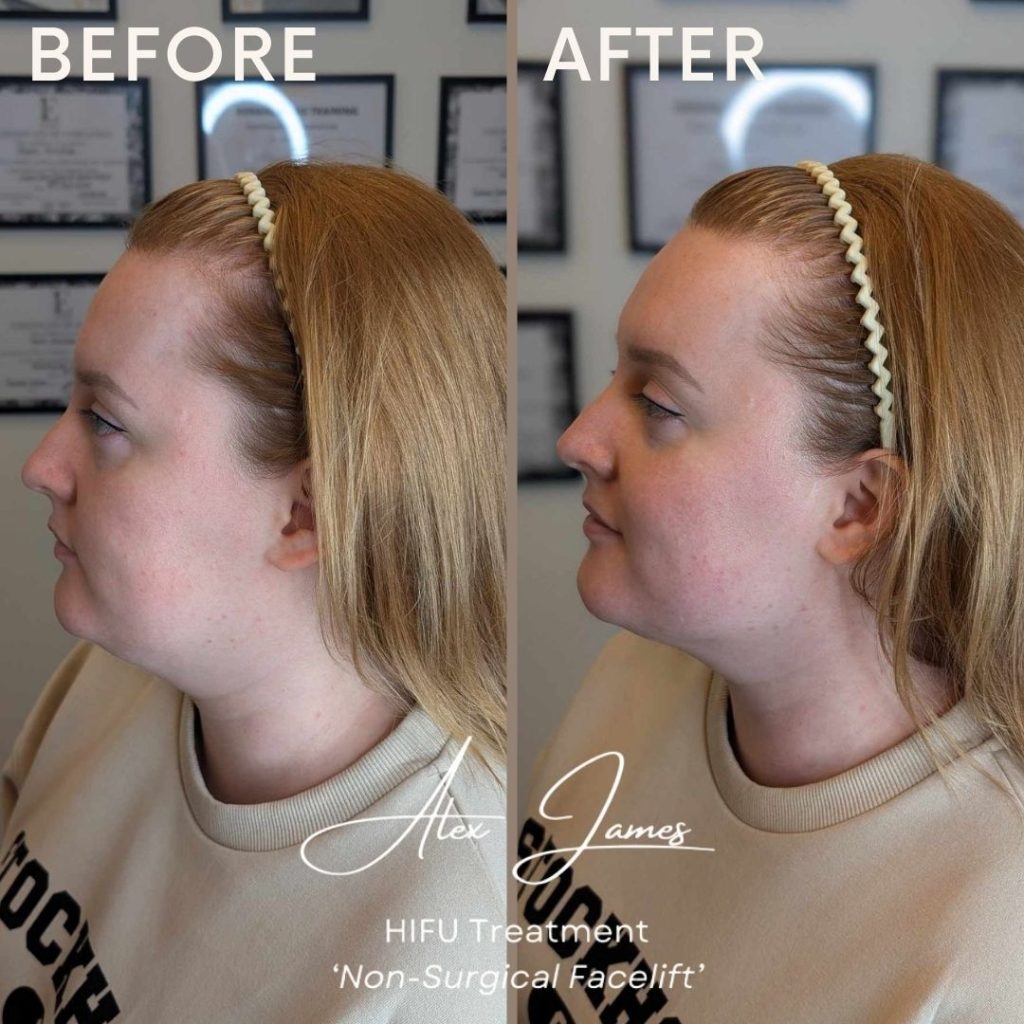
The skin becomes tighter, contours become more defined, and overall facial laxity reduces. Results continue improving for up to 4–6 months.
This gradual improvement makes HIFU a favourite for clients seeking natural-looking rejuvenation without dramatic changes or sudden enhancements.
To understand why HIFU is so effective, it helps to compare the layers of the skin that different treatments target.
|
Treatment |
Depth |
Result |
|
Skincare |
0–0.5mm |
Hydration, brightening, fine texture |
|
Microneedling |
0.5–2.5mm |
Collagen stimulation, texture improvement |
|
Radiofrequency |
0.5–3.0mm |
Tightening in upper layers |
|
HIFU |
1.5–4.5mm |
Structural lifting, tightening |
This deeper targeting is what makes HIFU facial treatments so successful for lifting jowls, tightening the lower face, and lifting the brows — areas where volume loss and tissue laxity often first appear.
When people talk about “skin tightening”, they usually think of the surface. But as we age, the deeper scaffolding beneath the skin loosens, which creates visible sagging.
The SMAS layer is:
During a surgical facelift, the surgeon lifts and tightens the SMAS. HIFU offers a non-surgical method of stimulating changes in this same layer, giving clients a natural lift without incisions, anaesthetic or major downtime.
This is why HIFU is often described as a “non-surgical facelift”, although results are naturally more subtle than surgery.
Clients often ask whether HIFU is painful. The experience varies, but the general sensations include:
Some areas, such as the jawline or forehead, can feel more intense because the ultrasound energy travels closer to bone. However, discomfort is brief, and most clients tolerate the treatment well without the need for numbing.
Many clients describe HIFU as: “Strange, but manageable.”
Treatments are completed within 30–90 minutes depending on the area.
HIFU is ideal for clients who want:
It is particularly effective for:
HIFU may not be suitable for:
Suitability is always determined during consultation.
HIFU appeals to clients because it is:
✔ Non-surgical: No incisions, no scarring, no anaesthetic.
✔ Non-invasive: No needles or injections.
✔ Highly targeted: Works at precise depths for structural change.
✔ Long-lasting: Results can last up to 12–18 months.
✔ Natural-looking: No frozen expressions or exaggerated lifting.
✔ Zero downtime: Return to normal activities immediately.
✔ Progressive: Results improve over time rather than appearing overnight.
In a world where clients want rejuvenation without drastically changing their appearance — HIFU perfectly bridges the gap between subtlety and effectiveness.
When clients first hear about HIFU treatment, they often assume it is simply a “tightening treatment.” In reality, it’s much more than that. HIFU is one of the most advanced technologies in non-surgical cosmetology because it produces multi-layered change: structural lifting, skin tightening, and long-term collagen remodelling.
In this section, we explore the deeper benefits of a HIFU facial, how results appear, which areas it can treat, and what makes it different from quick-fix aesthetic treatments.
Although HIFU is widely known for lifting and tightening, those results come from a series of deeper biological changes within the skin. These benefits make HIFU one of the most comprehensive non-invasive treatments on the market.
Here are the major benefits clients can expect:
One of the primary benefits of HIFU treatment is visible skin lifting, particularly in areas that commonly lose firmness with age:
The ultrasound energy contracts collagen fibres immediately, and then stimulates new collagen over time. This creates both instant tightening and long-term lifting.
Clients often notice:
The jawline is especially responsive to HIFU due to the depth of adipose and connective tissue in this area.
Many treatments offer short-term improvements, but HIFU is different — results continue to improve over weeks and months. This progressive improvement is what makes HIFU one of the longest-lasting non-surgical lifting treatments. HIFU triggers the biological process of neocollagenesis, where fresh, tighter collagen fibres replace older, stretched ones. This strengthens the skin’s framework and makes the treated area more resistant to future sagging.
Clients enjoy:
This delayed, continuous improvement is also why many clients see their best results at 3–6 months post-treatment.
A major advantage of HIFU is that results look completely natural. Unlike injectables that add volume or freeze muscles, HIFU works within your existing structure.
There is no:
HIFU enhances what you already have, rather than altering your natural facial anatomy. For clients who want to look refreshed and lifted without anyone knowing, HIFU is one of the most discreet aesthetic treatments available.
One of the biggest barriers for clients considering aesthetic procedures is downtime. HIFU involves no needles, no incisions, and no recovery period. Most clients go straight back to work or daily activities immediately. You may have slight redness that settles in less than an hour. Some clients experience mild tenderness for a day or two — but makeup, gym, work and social activities can continue as normal.
This makes HIFU extremely appealing for:
In an industry where many treatments require days of downtime, HIFU stands out for convenience and simplicity.
One of the key benefits of HIFU is targeting the SMAS layer, a structural tissue layer deep beneath the skin. This is the same tissue surgically tightened during a facelift — but HIFU does it without cutting the skin. Because of this, HIFU is often referred to as a non-surgical facelift.
Clients commonly choose HIFU when:
While HIFU is not a replacement for surgery in cases of severe skin laxity, it is one of the most effective non-invasive methods available for early to moderate laxity.
Although the deeper lifting effects of HIFU often get the most attention, the treatment also improves surface-level concerns, including:
This happens because new collagen fibres support the dermis more effectively. The result is not only a tighter appearance, but also a smoother, more refined complexion.
Unlike treatments that fade quickly — such as anti-wrinkle injections or superficial skin tightening — HIFU stimulates collagen deeply, which is why results last 12–18 months or longer depending on lifestyle. Some clients choose to maintain results with annual top-up HIFU facials, but many experience long-lasting lifting without frequent maintenance.
Although most people think of HIFU as a facial treatment, it can be used on various regions where skin laxity is common.
Facial Areas
Neck & Décolletage
Each area responds differently depending on skin thickness, age, hydration, lifestyle and genetics.
Clients often feel more comfortable when they know what will happen during treatment. HIFU follows a predictable process from start to finish.
Before your first HIFU treatment, we assess:
This ensures the treatment will be both safe and effective for your individual skin.
Before the treatment begins, the skin is cleansed to remove makeup, oil and impurities.
The practitioner maps out the areas to ensure even coverage and precise ultrasound delivery. The mapping stage determines the exact depth and positioning of the energy.
A cooling gel is applied to allow smooth applicator movement and optimal ultrasound conduction.
The HIFU device is applied to the skin while controlled pulses are delivered to specific layers. You may feel:
These sensations indicate the ultrasound energy is reaching the intended depth.
After the session, your practitioner will discuss what to expect over the next few days and weeks, including:
There is no downtime, and makeup can be applied shortly after treatment.
Click below for further information, or to get in touch for a consultation.
One of the most interesting aspects of a HIFU facial is that results occur in two distinct phases:
Immediate Results
Right after treatment, many clients notice:
This “instant lift” can vary, but it gives a glimpse of what to expect as deeper collagen production begins.
Long-Term Results (The Real Transformation)
Over 8–16 weeks, new collagen fibres form, thicken and strengthen the skin. This slow and natural improvement results in:
The best results typically appear around the 3–6 month mark.
Clients enjoy the fact that people notice the improvement — but can never quite pinpoint what has changed, because the results are so natural.
Clients often ask how HIFU treatment compares to other aesthetic treatments on the market. While HIFU is exceptional for deep lifting and structural tightening, it is not a “catch-all” solution, and it serves a completely different purpose than many other technologies. This section provides a clear, balanced comparison between HIFU and other popular treatments such as radiofrequency, microneedling, injectables, Morpheus8 and thread lifts. These comparisons help clients understand exactly what HIFU does — and equally important, what it doesn’t do. By the end, readers will have a realistic understanding of where HIFU sits in the world of non-surgical aesthetics and which goals it is best suited for.
Radiofrequency (RF) and HIFU both aim to improve skin firmness — but they achieve their results through different mechanisms and target different depths.
How RF Works
Radiofrequency uses electrical energy to heat the dermis, improving:
RF works closer to the surface (dermis) and is excellent for textural refinement and mild tightening.
How HIFU Differs
HIFU affects:
Where RF provides a general tightening effect, HIFU creates lifting effects by targeting layers that RF cannot reach.
Which Is Better?
Neither is “better” — they simply serve different purposes:
|
Goal |
Best Option |
|
Deep lifting |
HIFU |
|
Mild to moderate tightening |
RF |
|
Surface smoothing |
RF |
|
Jawline sculpting |
HIFU |
|
Skin refinement |
RF |
Yes. Many clients enjoy RF in between annual HIFU sessions because the combination supports both structural lifting and surface-level smoothing.
HIFU vs Microneedling
Microneedling is one of the most popular treatments for improving skin texture, scarring and superficial elasticity.
How Microneedling Works
Tiny needles create controlled punctures in the skin, stimulating collagen production in the upper dermis.
Microneedling improves:
How HIFU Differs
HIFU works in the deeper layers responsible for structural support — layers microneedling cannot reach.
HIFU improves:
Which Is Better?
It depends on the client’s concern:
|
Concern |
Best Option |
|
Skin texture |
Microneedling |
|
Acne scarring |
Microneedling |
|
Facial lifting |
HIFU |
|
Deep tissue laxity |
HIFU |
|
Mild tightening + texture |
Combination |
The treatments work beautifully together because they target different layers of the skin.
HIFU vs Morpheus8 or Fractional RF Microneedling
Morpheus8 and similar devices combine microneedling with radiofrequency. They target both the dermis and deeper layers of tissue.
How Morpheus8 Works
It uses:
It penetrates deeper than standard microneedling and is excellent for:
How HIFU Differs
HIFU reaches depths that even Morpheus8 cannot touch:
Which Is Better?
It depends on your goals:
|
Concern |
Best Option |
|
Deep structural lifting |
HIFU |
|
Jawline tightening |
HIFU or Morpheus8 |
|
Skin texture |
Morpheus8 |
|
Acne scarring |
Morpheus8 |
|
Needle-free treatment |
HIFU |
|
Brow lifting |
HIFU |
Both technologies have their role, but HIFU remains superior for non-invasive lifting.
HIFU vs Anti-Wrinkle Injections (Botox)
Anti-wrinkle injections work by temporarily relaxing facial muscles. They are excellent for:
How They Differ From HIFU
Botox:
HIFU:
Which Is Better?
They treat different issues:
|
Concern |
Best Option |
|
Forehead lines from expressions |
Botox |
|
Sagging skin |
HIFU |
|
Heavy brows |
Botox / HIFU brow lift |
|
Loss of structure |
HIFU |
|
Fine lines around the eyes |
Botox + skincare |
Many clients combine both treatments to address multiple concerns.
HIFU vs Dermal Fillers
Dermal fillers restore lost facial volume. They are used for:
How Fillers Differ From HIFU
Fillers:
HIFU:
Fillers give structure, HIFU gives lift — both can complement each other depending on the client’s goals.
HIFU vs Thread Lifts
Thread lifts involve inserting dissolvable sutures beneath the skin to physically lift tissues.
Thread Lifts Provide:
How HIFU Differs
HIFU provides:
Which Is Better?
Depends on preference:
|
Concern |
Best Option |
|
Immediate lift |
Threads |
|
Non-invasive lifting |
HIFU |
|
Long-term collagen |
HIFU |
|
Neck tightening |
Both |
|
Avoiding needles |
HIFU |
Clients wanting natural, needle-free results often choose HIFU; those seeking dramatic, fast improvement may choose threads.
HIFU vs “Skin Tightening” Home Devices
Home devices have surged in popularity — but it’s important to set correct expectations.
Most home devices use:
These tools provide minor, temporary tightening due to increased circulation and superficial stimulation.
What They CANNOT Do:
The difference in depth, intensity and medical-grade precision cannot be overstated.
Professional HIFU = Structural change
Home devices = Surface-level benefits
HIFU occupies a unique position in the aesthetics landscape:
It is the strongest non-invasive option for:
It bridges the gap between:
Because of its depth and precision, HIFU is considered the gold standard for non-surgical lifting in clients with mild to moderate laxity.
HIFU is widely regarded as one of the safest non-surgical aesthetic treatments available. However, like any procedure that stimulates change within the skin, clients should understand how safety assessments are carried out, what aftercare involves, and what realistic expectations look like. This section goes deeper into suitability, what you may feel during and after treatment, and commonly asked questions that help clients make informed decisions.
When carried out by trained practitioners using quality equipment, HIFU treatment is extremely safe. It has been used in medical settings for decades — not just within aesthetics but in deeper medical ultrasound applications — meaning the technology itself has a strong safety profile.
The ultrasound energy used in a HIFU facial is highly controlled, targeted and delivered at depths carefully selected for each treatment area. Because the energy bypasses the surface of the skin and targets deeper layers, the outer skin barrier remains intact, greatly reducing the risk of complications.
Safety Advantages of HIFU
✔ Non-invasive (no needles, incisions or anaesthesia)
✔ No tissue disruption at the surface
✔ Minimal risk of infection
✔ Suitable for a wide range of skin types
✔ No downtime or recovery period
✔ Long history of safe medical use
The treatment does not rely on heat diffusing through the skin (as radiofrequency does). Instead, it creates focused thermal points at depths only millimetres wide, preventing excessive surface heating.
HIFU has minimal side effects, and when they do occur, they are typically mild and short-lived.
Common temporary effects include:
These are all normal signs that the ultrasound energy has reached the targeted layers and triggered collagen contraction.
Rare but possible effects:
These effects are rare and usually related to individual skin sensitivity rather than the treatment itself.
Although HIFU is safe for most adults, certain conditions or circumstances may make it unsuitable.
HIFU may not be suitable for:
A thorough consultation is essential to ensure the treatment is appropriate, safe and able to achieve your desired results.
Aftercare: What To Do (and Not Do) After HIFU Treatment
One of the most attractive aspects of HIFU is the lack of downtime. However, aftercare still plays an important role in ensuring the best possible collagen response.
Do:
✔ Keep the skin hydrated
✔ Use SPF daily (minimum SPF 30)
✔ Drink plenty of water
✔ Follow practitioner advice
✔ Be gentle with the skin for 24–48 hours
✔ Expect gradual improvements
Avoid:
✘ Intense heat (saunas, steam rooms, hot yoga) for 48 hours
✘ Excessive sun exposure
✘ Harsh skincare products (retinoids / exfoliating acids) for 2–3 days
✘ Facial massages for one week
✘ Alcohol immediately after treatment (may worsen inflammation)
Proper aftercare helps preserve collagen and supports your skin’s natural rejuvenation cycle.
What Results Can You Realistically Expect?
HIFU is one of the most effective non-surgical treatments for lifting and tightening — but results will always vary based on age, lifestyle, genetics and how the body responds.
Great candidates will notice:
Results Timeline:
Maintaining results:
Many clients choose annual HIFU top-ups to keep the collagen network strong and prevent structural laxity from developing again.
Below are the most important, high-value FAQs your clients commonly ask — written in the same tone as your other evergreen articles.
HIFU is typically described as mildly uncomfortable but tolerable. Sensations include warmth, tingling or short bursts of deep vibration. Areas close to bone (jawline, forehead) may feel sharper sensations, but these are brief. Most clients rate discomfort between 3–6 out of 10, depending on sensitivity.
Treatments can take:
No downtime is required.
Most clients need one treatment every 12–18 months. Some may benefit from a second session at the 3–4 month mark depending on:
This is assessed during consultation.
No — HIFU cannot replace surgical outcomes for clients with significant sagging.
However, for mild to moderate laxity, HIFU is one of the best non-surgical lifting options available.
It is often considered:
This depends on the settings used, the device and the practitioner. Quality-controlled HIFU devices, when used correctly, target collagen structures rather than fat layers. In trained hands, HIFU is performed at safe depths that do not affect fat pads. Inexperienced practitioners using incorrect settings can cause unwanted fat reduction. This is why choosing a qualified and experienced practitioner is crucial.
Full results develop gradually, reaching their peak around 12–16 weeks after treatment. The lifting continues up to 6 months as collagen rebuilds.
Yes — combination treatments can enhance results. Popular combinations include:
The combination approach targets both surface texture and deep structural lifting.
Yes — many clients in their late 20s and 30s choose HIFU as a preventative treatment, strengthening collagen before visible laxity develops. Preventative HIFU can:
Yes. Makeup can usually be applied within an hour, once any redness has subsided.
Most clients enjoy results for 12–18 months, depending on:
Annual top-ups are recommended for maintenance.
Every clinic can offer HIFU technology — but HIFU results depend heavily on practitioner experience, treatment planning, safety understanding, and the precision of the technique used. That is where Alex James Clinic stands out. Based in Crawshawbooth, Rossendale, with strong transport links to Manchester, Lancashire and across the North West, we pride ourselves on delivering a professional, friendly and honest experience to every client who books a HIFU treatment — whether they are new to aesthetics or experienced in non-surgical procedures. This section highlights what makes your clinic different, why clients trust you, and the unique approach that aligns with your overall business ethos of transparency, expertise and exceptional customer experience.
Clients choose Alex James Clinic not simply because we offer HIFU treatment — but because of how we offer it. The treatment itself is powerful, but your delivery style, safety-first approach, and ability to guide clients confidently through each step make the experience genuinely exceptional.
Our core values include:
Our clinic is known for providing professional yet approachable care — a style clients appreciate when seeking cosmetic treatments that can feel unfamiliar or intimidating at first.
Here are the top reasons clients travel from across Lancashire, Manchester and the wider North West to book their HIFU facial with us:
Anyone can press a button on a machine — but true HIFU results rely on:
Our experience means clients can trust that their treatment is being performed safely and effectively by someone who understands the treatment far beyond surface-level training.
We do not oversell.
We do not promise unrealistic results.
And we do not recommend treatments unless they are suitable.
This transparency is especially crucial for clients investing in non-surgical lifting treatments. Clients feel reassured knowing they will receive unbiased advice, including suggestions for alternative treatments when HIFU isn’t the best choice for their needs.
Many clients choose Alex James Clinic because they want:
Located just outside of Manchester, but with easy travel links, clients benefit from:
This balance between professionalism and comfort creates the perfect treatment experience for clients across the North West.
Our clinic doesn’t use “one-size-fits-all” treatment patterns.
Instead, we assess:
From here, we map the treatment using the most effective combination of depths and energy lines, ensuring maximum benefit for the client’s individual needs. This personalised, anatomical approach is what truly elevates HIFU results.
Clients consistently report:
Our friendly, approachable nature makes clients feel safe and informed.
Clients never feel left on their own after treatment. You provide:
This ongoing support reduces anxiety, reassures clients throughout their collagen remodelling journey, and reflects the level of care your clinic is known for.
It’s important to highlight where your clinic sits — not only geographically but also within the local aesthetics landscape. Clients regularly travel from:
Because:
Our positioning outside of busy city clinics allows clients to access high-quality treatments without the stress, cost or rushed experience often associated with inner-city aesthetics clinics.
To help clients feel confident and comfortable, here’s what they can expect when they book a HIFU facial with you:
We assess:
This step ensures the treatment is safe, suitable and able to deliver the results they want.
We determine:
This is one of the most critical steps for achieving noticeable results.
Clients receive a structured, comfortable treatment with clear explanation throughout.
The process typically lasts between 30 and 90 minutes, depending on the area. No downtime is required.
You provide step-by-step advice to ensure the skin heals correctly and collagen production remains optimised.
Clients leave the clinic feeling informed, comfortable, and supported.
Our reputation is built on:
Clients often comment that they feel immediately at ease — a testament to the welcoming atmosphere and our skill in explaining treatments clearly and confidently.
While treatment prices may vary depending on treatment areas and depth mapping, clients can expect:
Prices can be updated within the clinic as needed, but the key message is clarity and fairness — something our clinic consistently upholds.
Clients who benefit most from HIFU treatment include those who:
HIFU is also an excellent preventative treatment for clients in their 30s looking to maintain collagen before noticeable ageing sets in.
At Alex James Clinic, clients can book their HIFU consultation via:
During the consultation, you will:
Your clinic approach is warm, informative and supportive — the perfect environment for clients considering non-surgical skin tightening for the first time.
HIFU treatment is one of the most advanced non-invasive facial lifting technologies available today. It offers:
Whether a client wants a more defined jawline, lifted brows, tighter neck skin, or overall firmer facial contours, HIFU is a proven and effective treatment that works from the inside out. At Alex James Clinic, clients receive more than just a treatment — they receive expert guidance, realistic advice, personalised care, and a comfortable, welcoming environment focused on safety and long-term results.
HIFU is not a trend — it’s a scientifically backed, results-driven treatment that continues to grow in popularity for a reason. When delivered by a qualified and experienced practitioner, it can make a transformative difference to your facial structure, confidence and long-term skin health.
Book your HIFU consultation at Alex James Clinic today to explore safe, long-lasting skin lifting with zero downtime.