

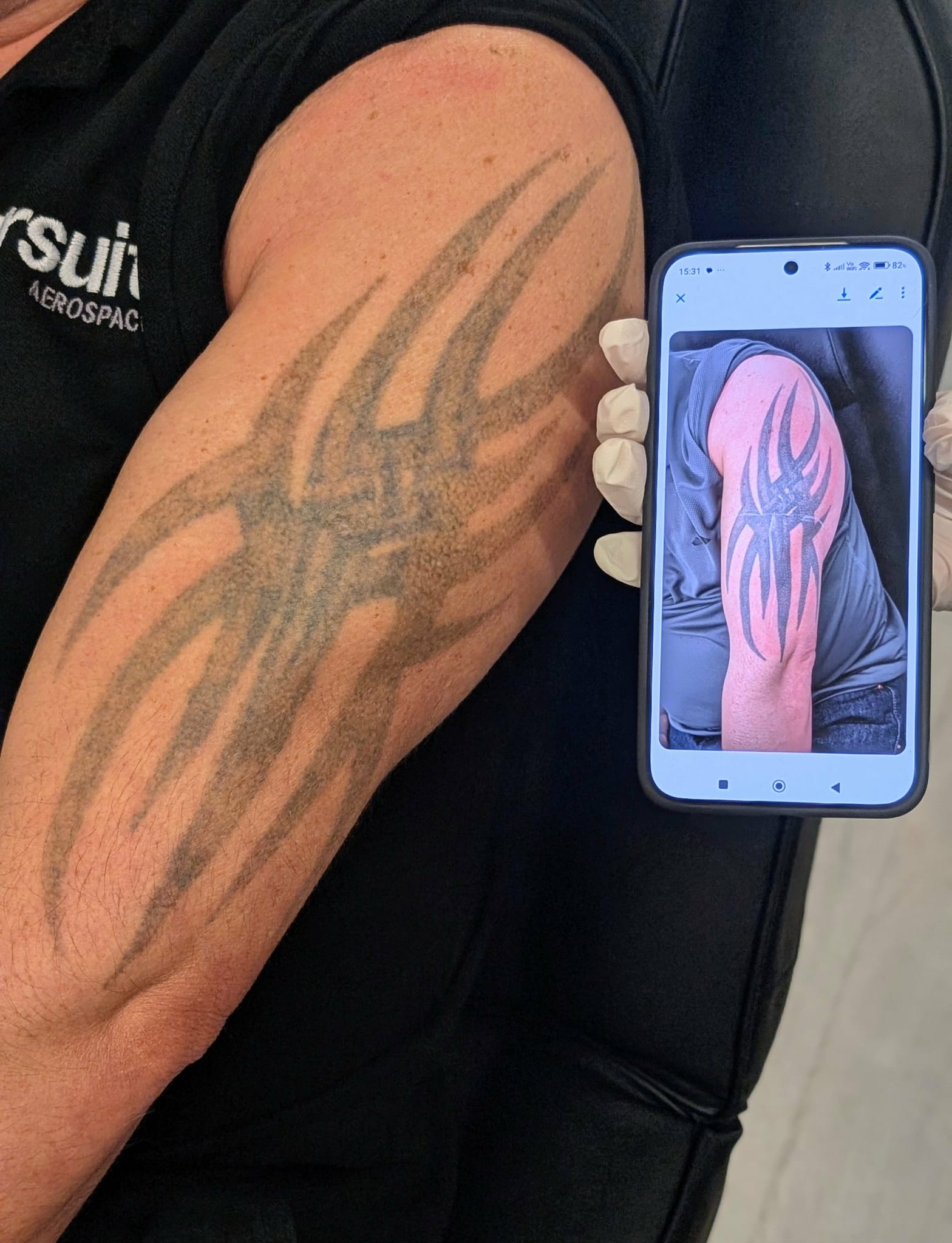
Tattoo removal has become one of the most sought-after aesthetic treatments in the UK, with thousands of people each year choosing to fade or fully remove unwanted tattoos. Whether it’s a tattoo from years ago that no longer represents you, a cover-up requiring lightening first, an impulsive design from your teenage years, or simply artwork that hasn’t aged well — laser tattoo removal remains the gold standard for safe, effective and controlled fading.
At Alex James Clinic in Rossendale, Lancashire, we specialise in professional laser tattoo removal for clients across the North West, including Manchester, Burnley, Preston, Bury, Blackburn and surrounding areas. Many people find us while searching for “tattoo removal near me” and choose us due to our honest approach, transparent pricing and strong commitment to client safety.
Laser tattoo removal is one of our core services, and we perform it daily. Because of this, we’ve heard every question possible — from concerns about pain levels and safety, to curiosity about how the laser works, how long it takes, and what the realistic outcome will be.
This article explains everything clients need to know at the beginning of their tattoo removal journey, with clear explanations that are easy to understand but still rooted in accurate science.
Laser tattoo removal is a non-invasive procedure that uses highly targeted light energy to break tattoo pigment into microscopic particles that the body can naturally remove. Unlike outdated removal methods — such as dermabrasion, acid removal, excision or DIY pens — laser light tattoo removal is safe, controlled and specifically designed to target ink without damaging the surrounding skin.
At Alex James Clinic, we use a professional Q-switched ND:YAG laser, the industry’s most trusted technology for breaking down tattoo pigment efficiently and safely. This system uses ultra-short pulses of energy to shatter ink particles while preserving skin integrity.
The goal of laser tattoo removal is not to burn the skin or “pull” the ink out — it is to fragment the tattoo pigment so your immune system can gradually flush it away.
To understand why tattoo removal requires laser technology, it helps to understand how tattoos are created. A tattoo machine deposits ink deep into the dermis, the second layer of the skin. This is deeper than the epidermis, which sheds naturally over time.
Once ink is placed:
This is why tattoos are long-lasting. The ink sits in a layer of the skin that does not shed, and the pigment is too large for the immune system to break down naturally.
To remove a tattoo, we must break pigment particles into pieces small enough for the body to eliminate — and laser technology is currently the only method that can achieve this safely.
Laser tattoo removal works through selective photothermolysis, which means:
This is why ND:YAG laser technology remains the industry gold standard for tattoo removal — it targets the pigment safely without damaging the surrounding tissue.
At Alex James Clinic, we treat:
We are always transparent about results, especially for colours that are notoriously stubborn, such as light blues or greens.
There are many types of lasers, but ND:YAG is the safest and most versatile for tattoo removal — particularly for clients with Fitzpatrick skin types 1–4, which is what we treat.
ND:YAG lasers can produce multiple wavelengths:
1064nm
✔ Best for black
✔ Best for dark blue and deep pigments
✔ Safest for darker skin types
✔ Essential for cover-up lightening
✔ Deep penetration for stubborn ink
532nm
✔ Best for red, orange, some yellows and warm-toned pigment
✔ Shallower wavelength for brighter colours
✔ Effective for many cosmetic tattoos as well
This dual-wavelength capability allows us to tailor treatments based on your tattoo’s unique characteristics.
While some clinics heavily market PicoLaser systems, ND:YAG remains the most proven, reliable and widely used system globally for consistent tattoo removal. We focus on what works safely and effectively — not on buzzwords.
One of the biggest misconceptions is the idea that a tattoo can be removed in one treatment. No professional laser clinic will ever promise this. Tattoo removal is a gradual process, because each session breaks down only a portion of the ink.
After treatment:
This slow, controlled approach protects your skin and reduces the risk of scarring or pigmentation changes.
Depending on the tattoo, its age, density, ink type and location on the body, clients may need anywhere from 6 to 12+ sessions for significant fading or removal. Some tattoos (especially multi-coloured pieces) require more.
Many factors influence fading speed:
Ink Colour
Age of the Tattoo
Older tattoos tend to fade faster because pigment has already naturally broken down over the years.
Ink Depth and Application Technique
Location on the Body
Areas with strong circulation (upper body) lighten faster.
Hands, feet and lower legs can take longer.
Immune System Efficiency
Hydration, general health and lifestyle habits all influence how quickly your body flushes pigment.
These variables are always discussed clearly during consultations.
Laser tattoo removal is often perceived as painful, but most clients find the sensation far more manageable than expected.
Common descriptions include:
At Alex James Clinic, we use advanced cooling before and during treatment to minimise discomfort, making sessions far easier for clients.
Treatments are also extremely quick — many tattoos take only 1–10 minutes per session depending on size.
Yes — when performed by trained professionals using high-quality equipment.
We prioritise:
Many risks associated with laser tattoo removal come from:
Professional treatment dramatically reduces the chance of:
Your skin integrity is our absolute priority — and we always emphasise safety over speed. Click the button below for further information or to register your interest.
Laser tattoo removal is one of the most fascinating aesthetic treatments because it works with your body rather than against it. Unlike procedures that deliver an instant change, tattoo removal relies on a biological process that unfolds steadily over time. For this reason, clients who understand the stages of fading, the healing timeline, and what the laser is actually doing at each appointment always feel more confident and reassured throughout their journey.
This section explains the full treatment process step-by-step, including what happens during the appointment, how the immune system removes shattered pigment, what changes you can expect between sessions, and why proper spacing is essential for safe, effective fading.
Before we explore the healing timeline, it’s important to understand what actually happens during each treatment. A typical laser tattoo removal appointment at Alex James Clinic includes the following stages:
Consultation & Patch Test
Before your first session, we begin with a detailed consultation to assess:
Every client receives a patch test during this appointment. This allows us to:
On the day of treatment:
We never rush this stage. Ensuring the tattoo is fully visible and the skin is ready makes the treatment safer and more effective.
Cooling Application
To improve comfort and protect the skin, cooling is used before, during and after the laser treatment. This greatly reduces the heat and “flicking” sensation that clients often worry about. Unlike outdated removal methods, modern laser removal is significantly more tolerable thanks to advanced cooling techniques.
Laser Mapping & Treatment Delivery
The practitioner then carefully maps the tattoo to ensure precise and even coverage.
During the treatment:
Each pulse is over in a fraction of a second, and most treatments take:
Immediate Post-Treatment Response
Immediately after treatment, you may notice:
The whitening / frosting effect is temporary and simply indicates that gases beneath the skin have risen during the pigment-shattering process. It typically fades within minutes. Cooling is applied again to soothe the area and reduce heat buildup.
Tattoo fading happens in stages — and each stage plays a crucial role in achieving safe, effective removal without damaging the skin. Many clients mistakenly believe fading happens right after the laser. In reality, the laser only performs the first step (breaking the ink). The body then takes over the rest. Here’s what to expect:
0–48 Hours After Treatment
What you may experience:
These are all normal and indicate a healthy response to treatment.
What NOT to do:
What you CAN do:
1–3 Weeks After Treatment
This is when clients often say: “It doesn’t look like it’s changed much.” This is completely normal. What’s happening during this phase:
4–6 Weeks After Treatment
This is when fading becomes clear for most people. Clients typically notice:
This is the point where your body has removed a significant portion of the shattered pigment. This stage is also when many clients feel excited because they visibly see progress.
6–10 Weeks After Treatment
Between weeks 6–10, fading continues and deep ink begins lifting. Many clients at this stage say:
“It looks completely different to how it started.” or “I can finally imagine what it will look like removed.”
The tattoo appears much lighter, softer and less defined.
This phase is crucial because:
A common question is: “Can I come sooner to speed it up?”
The answer is no — and here’s why:
Over-treating the same area can damage collagen or cause scarring.
This is why we space sessions 6–10 weeks apart, depending on:
Spacing sessions correctly ensures:
The number of sessions depends on several factors:
Professional tattoos: Typically 8–12+ sessions, as ink is deeply packed and heavily saturated.
Amateur tattoos: Often 3–6 sessions, as ink tends to sit more superficially.
Colour tattoos: These vary widely depending on pigment, with some requiring 10–15 sessions for full removal.
Old tattoos: These usually fade faster as pigment has already broken down over time.
Cover-ups: These require more sessions because of the density of layered ink.
Cosmetic tattoos (brows, PMU): Best treated with laser brow removal techniques, not tattoo settings.
At Alex James Clinic, we always provide a realistic range, never overpromising or guaranteeing full removal where it may not be possible.
Laser breaks the ink — your body removes it. This means lifestyle factors influence clearance speed significantly.
Faster fading occurs in clients who:
Slower fading occurs when:
This is why progress varies from person to person — even when tattoos look similar at the start.
This is one of the most misunderstood aspects of tattoo removal. The laser does not remove the tattoo — your lymphatic system does.
Here’s what actually happens internally:
This process is natural and safe — the body is constantly filtering and clearing particles every day.
Absolutely. Most clients continue to see fading up to 12 weeks after each session. This steady, progressive improvement is a sign of:
This is also why rushing sessions is counterproductive.
Spacing sessions strengthens results.
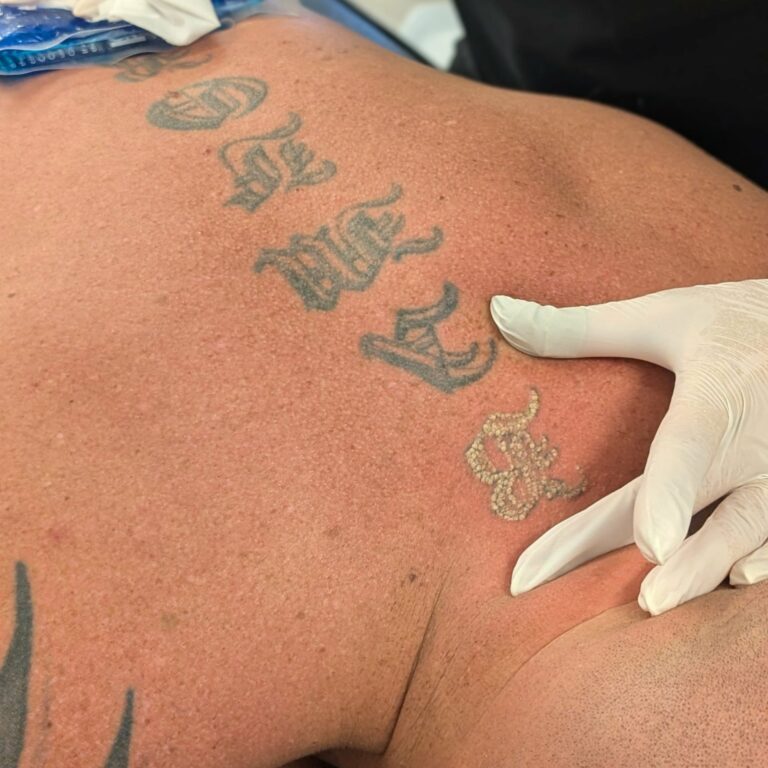
Every tattoo — and every body — responds differently to laser removal. While the technology itself is advanced and consistent, results vary depending on ink, skin, placement, lifestyle, and countless individual factors. Because of this, one of the most important parts of a tattoo removal journey is having clear, realistic expectations from the start.
This section explains exactly what results clients can expect at each stage, why some tattoos fade beautifully while others are more challenging, and how to recognise normal patterns during the process. By understanding how tattoos respond over time, clients feel more confident and reassured throughout the journey.
Laser tattoo removal does not produce immediate results. Instead, fading follows a predictable pattern that unfolds over months. Here’s a clear overview:
Within the first 24–72 hours, you may see:
The darkening is normal — when ink particles shatter, they can briefly look more concentrated. This resolves as the immune system begins clearing pigment.
You will not see significant fading immediately.
The real transformation begins over the following weeks.
Around the 3–6 week mark, the tattoo will begin to lighten. Typical changes include:
This is the stage where clients often say: “I can finally see it changing.” This early fading confirms the laser successfully reached the pigment and your immune system is responding effectively.
As your body continues clearing fragmented ink:
This stage is often the most encouraging, as visible progress aligns with the internal healing process. This is also the ideal point for your next session if your skin has fully healed.
By this stage, clients typically notice:
Some tattoos at this stage look ready for:
For many clients, a cover-up becomes significantly easier and more successful after 3–5 well-spaced sessions.
Tattoos fade in layers, not all at once.
Later sessions focus on:
Even when a tattoo appears faint, deep ink often remains beneath the surface. This is why the final 2–4 sessions make the biggest difference.
Many clients feel concerned when they see:
This is completely normal.
Here’s why tattoos fade unevenly:
Patchiness is a sign that the laser has done its job and the body is actively clearing pigment. The tattoo becomes more uniform as sessions progress.
Another normal response is temporary darkening after the first session. This happens because:
Darkening is not a step backward — it means the ink has been disrupted and is preparing to fade.
Many colour tattoos, especially those containing titanium dioxide (common in cosmetic tattoos), also darken initially.
This is expected and resolves with continued treatment.
Clients frequently ask whether tattoo removal hurts more than getting a tattoo.
The general experience is:
Tattoo application = continuous scratching
Laser removal = short, sharp bursts
Tattoo = prolonged discomfort
Laser = quick pulses lasting minutes
Most clients describe removal as:
“A hot flick” – “A rubber band snap” – “Not as bad as expected” – “Way quicker than getting the tattoo”
At Alex James Clinic, we use advanced cooling systems that significantly reduce discomfort during each session. This makes the treatment far more manageable.
Not all tattoos can be fully removed — and no clinic should guarantee it.
However, most tattoos will fade significantly, and many can be cleared close to 100% depending on several factors.
Tattoos That Usually Clear Very Well
✔ Black ink
✔ Older tattoos
✔ Amateur tattoos
✔ Minimal shading
✔ Tattoos on upper body areas
✔ Tattoos with moderate saturation
Tattoos That May Require More Sessions
✔ Dark blue
✔ Dense black outlines
✔ Multi-layered cover-ups
✔ Deep professional ink
✔ Tattoos on feet / hands / lower legs
Tattoos That Can Be More Stubborn
✔ Bright green
✔ Light blue
✔ Aqua
✔ Pastel colours
✔ Some cosmetic pigments
These colours contain mineral compounds that do not always break down evenly.
Clients see improvement, but not always full removal.
Seven major factors determine how well a tattoo will respond to laser treatment:
Tattoo Age
Older tattoos fade faster
Pigment has already been broken down over time
The immune system is already familiar with the ink
Tattoo Colours
Black absorbs laser light best → easiest to remove
Red responds well → usually medium difficulty
Green, blue & aqua → most resistant
Ink Density & Saturation
Highly packed ink takes longer because:
More pigment = more sessions
Deeper layers must be reached gradually
Shading or lightly packed tattoos respond faster.
Ink Quality
Professional ink is: Denser, Higher-quality, More stable, .More deeply implanted
Amateur ink often responds quickly.
Tattoo Depth
Deep ink requires deeper laser penetration.
This must be done safely and gradually.
Immune System Efficiency
Clients with stronger immune systems often see faster fading.
Helpful habits include: Hydration, Exercise, Good circulation, Avoiding smoking, Following aftercare.
Placement on the Body
Areas with better blood flow fade fastest: Shoulders, Arms, Upper back, Chest
Areas with slower circulation fade slower: Wrists, Ankles, Hands, Feet, Lower legs
Many clients choose laser removal not to fully remove their tattoo, but to lighten it enough for a successful cover-up.
Here’s when a tattoo is ready:
Cover-ups are far more successful when laser light tattoo removal is used beforehand. This is one of the most common reasons clients book with us.
A complete tattoo removal journey typically takes:
Some clients see near-complete removal in as few as 6 sessions, while others may need 12–14 or more. We never rush sessions — slow, controlled fading produces the best long-term outcome.
Laser tattoo removal is highly effective — but honest communication is essential.
We always explain:
Clients feel more confident when they understand these details from the start.
Tattoo removal is one of the most effective and safe aesthetic procedures when carried out correctly — but only when performed by qualified professionals using certified equipment and clinically approved protocols. Because tattoo removal works by leaving the body to remove fragmented ink, the process relies heavily on safety, patience, expertise and proper aftercare to achieve the best possible results.
In this section, we explore the full spectrum of safety considerations:
✔ What makes laser tattoo removal safe
✔ Why ND:YAG is the gold standard
✔ The dangers of cheap tattoo removal
✔ Why alternatives are ineffective or dangerous
✔ How to prevent scarring
✔ What proper aftercare looks like
✔ What side effects are normal vs. what isn’t
By the end of this section, readers will understand exactly how to protect their skin, why choosing the right practitioner matters, and what steps ensure the best outcome.
Laser tattoo removal has been used for decades and is considered one of the safest non-invasive aesthetic treatments when:
At Alex James Clinic, your safety is at the forefront of every decision. We prioritise:
✔ Fitzpatrick suitability (1–4 only)
✔ Patch testing
✔ Appropriate laser energy settings
✔ Detailed client consultation
✔ Cooling throughout treatment
✔ Integrity of the skin
✔ Avoiding over-treatment
✔ A comfortable, supportive environment
The goal is always effective results without compromising skin health.
The ND:YAG laser has been the most widely used and clinically trusted tattoo removal system globally for decades.
Why ND:YAG is the safest choice:
✔ It penetrates deeply without harming the epidermis
✔ It targets pigment precisely
✔ It is suitable for multiple colours
✔ It is safe for Fitzpatrick 1–4 (your clinic’s range)
✔ It minimises risks of hyperpigmentation
✔ It causes less inflammation compared to other wavelengths
Many clients ask about Pico laser systems because they are heavily marketed online. While Pico lasers can work well:
Your clinic’s approach is based on clinical results, not marketing trends.
Clients often come to us after trying (or considering) alternative tattoo removal techniques. It’s essential to understand the risks associated with non-laser methods.
Here’s a breakdown of common alternatives and why we strongly advise against them.
(Trichloroacetic acid, glycolic acid, or chemical kits)
Dangers:
❌ High scarring risk
❌ Burns the epidermis
❌ Does not reach the dermis (where ink sits)
❌ Causes permanent texture damage
❌ Unregulated, often sold online
❌ Often results in worse appearance than the tattoo itself
Acids remove skin, not ink — a dangerous misconception.
Popular for cosmetic tattoo removal but not suitable for body tattoos.
Issues:
⚠️ Causes scabbing
⚠️ Limited penetration
⚠️ Poor results on deep ink
⚠️ High risk of scarring on large tattoos
⚠️ More painful than laser for many clients
This method is designed for superficial PMU pigment — not tattoo ink in the dermis.
Dangers:
❌ Extremely damaging
❌ Removes layers of skin
❌ Long healing time
❌ Significant scarring risk
❌ Cannot reach deep pigment
Dermabrasion is considered outdated and unsafe for tattoo removal.
Often found online, widely advertised, almost entirely ineffective.
Issues:
⚠️ Zero impact on the dermis
⚠️ Can cause topical burns
⚠️ Result in hypopigmentation
⚠️ Waste of money
⚠️ False advertising
Creams cannot penetrate deep enough to affect ink. If they could, they would burn the skin off — which is exactly the problem.
Pros:
✔ Removes small tattoos fully
Cons:
❌ Leaves a scar
❌ Only suitable for tiny tattoos
❌ Not appropriate for medium/large designs
❌ Recovery time required
This method is rarely chosen unless removal must be immediate.
Many people search for “cheap tattoo removal” online and are drawn to low-cost providers or untrained operators who promise fast results at bargain prices.
This is extremely risky.
Cheap tattoo removal often means:
❌ Unqualified practitioners
❌ Unsafe equipment ordered online
❌ Over-treatment
❌ Incorrect wavelengths
❌ No patch testing
❌ No aftercare guidance
❌ Higher risk of burns
❌ Higher risk of scarring
❌ Irreversible skin damage
Fixing damage from poor laser treatment is far harder — and sometimes impossible — compared to working with a trained professional from the start.
At Alex James Clinic, our pricing is fair, competitive and transparent, but never “cheap” at the cost of safety.
Every aesthetic treatment carries some risks, but laser tattoo removal is considered very low risk when performed correctly.
Here’s what you might experience — and how we reduce risks:
Very common and usually mild. Resolves within 48 hours.
Blisters can occur as part of the body’s healing response. They are normal and should never be popped. Proper aftercare prevents complications.
Some tattoos form small scabs during healing. Picking at these increases risk of scarring. We provide guidance to prevent this.
More common in darker skin tones or recent sun exposure. This is why we treat Fitzpatrick 1–4 only and always patch test first.
Extremely rare — usually caused by:
We minimise this risk through safe spacing, correct energy settings and careful assessment.
Proper aftercare is one of the biggest factors in preventing complications.
DO:
✔ Keep the area clean and dry
✔ Apply aftercare products as advised
✔ Use cool compresses for swelling
✔ Allow scabs or blisters to heal naturally
✔ Drink lots of water
✔ Avoid tight clothing rubbing the area
✔ Wear SPF 50 on exposed tattoo areas
✔ Follow spacing guidelines
DON’T:
❌ Pick or scratch the skin
❌ Pop blisters
❌ Use acids or skincare products on the area
❌ Expose the area to sun or tanning beds
❌ Apply fake tan over healing skin
❌ Visit saunas, steam rooms or swimming pools for 48–72 hours
❌ Shave directly over the area during healing
❌ Get another session too soon
Following correct aftercare dramatically improves your long-term results.
Immediately After Treatment
First 24–48 Hours
3–7 Days Post Treatment
7–14 Days Post Treatment
4–12 Weeks Post Treatment
Sun exposure increases complications because:
We strongly recommend:
✔ SPF 50
✔ Covering the area outdoors
✔ Avoiding sunbeds completely
We do not perform tattoo removal during:
There is no clinical benefit and several potential considerations.
We always postpone treatment until safe.
Laser tattoo removal should not be combined with:
These interfere with healing or increase irritation.
Safe treatments that can be combined later include:
We always advise clients individually.
Choosing the right clinic for laser tattoo removal can feel overwhelming. There are countless options online, all promising fast results, different technologies, low prices, and “guaranteed removal.” For most clients, the decision becomes difficult — until they understand that tattoo removal is not about the cheapest price, the flashiest machine, or the quickest fix.
It’s about:
And that is exactly what sets Alex James Clinic apart. Based in Crawshawbooth (Rossendale), Lancashire, with excellent travel links to Manchester and the North West, the clinic has become a trusted name for professional laser tattoo removal — for clients travelling both locally and from across the UK. This final section of the article explores what makes the clinic different, how the treatment journey works, what pricing looks like, and why hundreds of clients have trusted the clinic for safe, transparent and effective laser tattoo removal.
Many clinics offer laser tattoo removal — but very few specialise in it. At Alex James Clinic, tattoo removal is one of the core services, performed every single week, with extensive experience treating:
Clients appreciate the clinic’s:
✔ Professionalism
✔ Welcoming, friendly environment
✔ Clear explanations
✔ Realistic expectations
✔ High level of safety
✔ Strong aftercare
✔ Genuine passion for helping people feel confident again
Your approach is never rushed, never pushy, and always focused on ethical treatment.
One of the biggest reasons clients choose Alex James Clinic is the balance between professionalism and approachability.
The clinic environment is:
Unlike many high-turnover city clinics, which often feel rushed or impersonal, you provide a relaxed, supportive experience where clients feel comfortable asking questions and expressing concerns. Clients often comment that they feel instantly at ease, which helps reduce anxiety — especially for those nervous about laser treatment.
People regularly travel from: Rossendale, Rawtenstall, Bacup, Burnley, Bury, Accrington, Blackburn, Bolton, Preston, Rochdale, Manchester, Greater Manchester, Across Lancashire and beyond.
Why? Because the clinic is:
Many clients say their experience feels “more personal and more professional” than previous clinics they’ve visited.
Tattoo removal is part science, part artistry, and part skin understanding. It requires precise laser control, correct skin analysis and the ability to adapt settings safely based on:
Your training, experience and daily hands-on practice make the difference between:
✔ A clean, even fade
vs
✘ Patchiness
✘ Over-treatment
✘ Scarring
Clients trust us because:
This is how we protect clients and deliver strong results.
Our clinic is known for its honest and realistic communication style.
We do not oversell.
We do not guarantee impossible results.
We do not artificially inflate pricing.
We do not push clients to book immediately.
Instead, we provide:
This transparency is one of the biggest reasons clients return and recommend our clinic to family and friends.
Many people search for “cheap tattoo removal”, but the reality is that quality treatment should be safe, not cheap.
At Alex James Clinic, pricing is: Transparent, Competitive, Based on tattoo size, Designed to be fair for all clients, Reflective of the experience and safe equipment used.
Our pricing structure:
Small tattoos: Starting from £50
Medium tattoos: Starting from £75
Large tattoos: £125
Extra-large: £200
Additional notes:
Patch test and consultation included. No hidden fees. No pressure to book multiple sessions. Tailored advice based on tattoo and goals. Clients feel comfortable knowing exactly what to expect financially.
Most clients with unwanted tattoos are suitable for treatment, but suitability is always assessed during consultation.
Suitable:
✔ Fitzpatrick skin types 1–4
✔ Adults aged 18+
✔ Black and dark ink tattoos
✔ Red and orange tattoos
✔ Older tattoos
✔ Amateur tattoos
✔ Cover-up lightening
May Require Additional Guidance:
– Coloured tattoos (light blue, green)
– Very deep professional ink
– Tattoos on lower legs/feet
Not suitable:
✘ Pregnant clients
✘ Breastfeeding clients
✘ Clients with certain medical conditions
✘ Recently tanned skin
✘ Fitzpatrick types 5 and 6
✘ Anyone unwilling to follow aftercare
Consultations are friendly, thorough and informative.
They typically include:
You ensure clients understand every step before beginning treatment.
Based on consistent feedback, the top reasons clients choose our clinic are:
✔Our honesty about results: We never overpromise or create unrealistic expectations.
✔ Our safe and experienced technique: We protect the skin above all else.
✔ Our friendly and approachable nature: Clients feel comfortable from start to finish.
✔ Our transparent pricing: No hidden fees, no gimmicks.
✔ Our strong track record: Our results and reputation speak for themselves.
✔ Our comfortable clinic environment: Professional but never intimidating.
✔ Our willingness to answer questions: Clients appreciate the clarity and confidence we provide.
✔ Our ethical, client-first approach: We care about the long-term health and outcome for every client.
This combination of experience, safety and kindness is a rare balance — and one that genuinely matters.
Booking is easy and straightforward.
Clients can contact us via:
During booking, clients can request:
We offer flexibility with appointment times where possible and provide treatment within a realistic and safe timeline.
Tattoo removal is a journey — not a quick fix. But with the right practitioner, realistic expectations and consistent aftercare, it can produce life-changing results.
Laser tattoo removal:
✔ Is the safest method
✔ Works with your body
✔ Breaks ink at a cellular level
✔ Fades tattoos in layers
✔ Can restore skin clarity
✔ Makes cover-ups far easier
✔ Offers long-term, permanent improvement
Choosing a trained, ethical practitioner ensures your journey is:
At Alex James Clinic, every client is treated with respect, honesty and care — no judgment, no pressure, and no unrealistic promises. Just a genuine commitment to helping people feel confident, happy and free from ink they no longer want.
Your tattoo may have been permanent, but living with it doesn’t have to be.